
Inspiration-Letters 6
Meditation Issue
Dear Reader,
 When I had only been a student of Sri Chinmoy’s for a very short time, my best friend, who had introduced me to Sri Chinmoy’s teachings contacted me on the phone:
“Mahiruha, guess what! Sri Chinmoy has announced that tomorrow will be held a thirteen-hour meditation!”
I said, “Oh, that’s wonderful,” and excused myself because my microwaved popcorn was ready.
As I munched on the popcorn, I wondered how in the world was I supposed to meditate for thirteen hours?
Sri Chinmoy actually recommends that people meditate for no more than one hour and a half or two hours at a stretch, maximum.
So, what was going on?
I drove up to New York in the evening, and the meditation began at one o’clock in the morning. It began with a long, sublime, silent meditation. After that, Sri Chinmoy’s various choirs or singing groups came up on stage to sing devotional songs.
After that, Sri Chinmoy played on the piano. It was an extremely powerful and haunting piano performance, one of the best I have ever heard. Perhaps the recording of it is available somewhere.
After the piano performance, there was a short intermission. Sri Chinmoy walked over to the aisle behind me and said to an older gentleman, “I understand that you are a great pianist.”
The man nodded and smiled.
“You may know how to play the piano, but I can break the piano!” Sri Chinmoy said enthusiastically.
The pianist laughed, delighted with Sri Chinmoy’s childlike charm and self-effacing humour.
I realized then, that this thirteen hour meditation was to be broken up into various segments of silent meditation, prayer, devotional chanting, poetry recitation and singing. Sri Chinmoy was trying to inspire us that everything we do in the spiritual life can be a form of meditation, and that our service to the world cannot be separated from our attitude towards God or our Higher Power.
I enjoyed Sri Chinmoy’s comment about breaking the piano because at that time I had been studying Beethoven’s late string quartets with great interest. I understood that when Beethoven first premiered his quartets, people thought he had gone insane. And even his contemporary biographers, praised him back-handedly, that his motives were pure, even if his music didn’t make sense. Now, of course we know that his late works, his piano sonatas and late string quartets are among humanity’s ultimate artistic achievements.
My very favorite composer, Bach, suffered a similar fate, when his greatest works, his vocal pieces especially, fell into an inexplicable obscurity for a eighty years after his death.
During that long meditation with Sri Chinmoy many years ago, Sri Chinmoy handed us copies of a poetry book that I’ve always treasured, entitled “Sail, my heartbeat, sail,” a collection of rhyming poems, at once aphoristic and simple, and yet lyrical
Two of my favorite poems from this book are:
My prayer
Tells me Whom to beg only,
Deep within,
Wide without, sempiternally.
- Sri Chinmoy
Sail my heartbeat sail, sail
To clasp our Lord's Nectar-Mail.
- Sri Chinmoy
This second poem reminds me of Walt Whitman's wonderful 'Leaves of Grass', where he writes:
A child said, What is the grass? fetching it to me with full hands;
How could I answer the child?...I do not know what it is any More than he.
I guess it must be the flag of my disposition, out of hopeful green stuff woven.
Or I guess it is the handkerchief of the Lord,
A scented gift and remembrancer designedly dropped,
Bearing the owner's name someway in the corners, that we may see
And remark, and say Whose?
- Walt Whitman
To finish my story, at the end of that epic thirteen-hour meditation, we all walked into the bright summer sunshine, as fresh and awake as if we had just enjoyed a week of sound sleep. Sri Chinmoy said later that we had meditated extremely well and that he was very proud of us. And I was happy that I had been able to spend so much time with my meditation teacher and with my fellow students. It was a real adventure.
I hope these articles on meditation inspire you to seek for those stray letters and dropped handkerchiefs of God in your own life. The variety of topics, themes and styles this time is certainly refreshing!
Mahiruha Klein
Editor
Title photograph by Pavitrata Taylor


I always knew the best place in town to eat.
Canberra, my home city, is the capital of Australia – but don’t expect a hectic metropolis. It exists in the cosy realm between a small town and a “real” city, with most of the conveniences but less of the exhaustion. Canberra’s best restaurants are world-class, apparently.
Some years ago, as a frequently broke, unemployed student, I was shown a spot in the city centre, which some of my friends would visit every Friday night. In a wide arcade, surrounded by busy shops and trendy restaurants, a picnic was set up. Various youths gathered around, dressed in scruffy garments. An elderly lady, in a thick brown jacket, approached me with a kind smile. “Would you like some soup?” she asked in a strong accent that sounded perhaps eastern European, exact location unknown.
Uncertain of how to respond, I graciously accepted her invitation. She went to a large pot and served me a polystyrene cup of rich, home-made vegetable soup. At her insistence, I went to the table next to the soup, to take my pick from several slices of fresh bread which some of her younger friends were buttering cheerfully.
The soup was superb. Not exactly a secret recipe, but it had a certain quality to it that made it taste as good as anything I had ever tried. As soon as I finished, she quickly turned to me. “Would you like some more?” I had to answer yes – not to be gracious this time, but simply because it was too good an offer to turn down.
She had some helpers, but this old lady was obviously the leader of this happy group of food-providers. One of them told me that she would spend the day making soup from the vegetables growing in her garden – and in fact, I couldn’t imagine any other possibility. She and her friends would then take two large metal pots of soup to town, along with plenty of bread, and serve it to the kids on the street. The effect was like sorcery. I knew some of her regular customers: not street kids, but their parents would no doubt describe them as having an “attitude problem”. They were abrasive, rebellious people in their late teens – until they sat down with this lady for soup and fresh bread. “Momma” was all anyone called her, and it seemed fitting.
She would embrace some of her regulars, and greet everyone with good cheer. One of the girls I knew back then – who was usually one of the rudest, most unpleasant people I knew – would sit there, grinning sheepishly, suddenly humbled by the encounter. “How could one lady be so nice?” she said. And she meant it. Momma would infect everyone she met with her sweetness.
I too became a regular, introducing some of my own friends to her open-air soup kitchen. Even after I found myself with a steady job, and no need for such charity, I still dined out with Momma on Friday night, offering her a donation for her troubles. She refused to accept it, but insisted on serving me another cup of pumpkin soup to reward my attempted generosity. She once looked at the small crowd of youngsters who had gathered to enjoy her hospitality that night. “These are my children,” she said proudly to a visitor from Greenland. “They come and go. Some of them get jobs. Some of them end up in jail. But there is always someone here to serve.”
As I said, Canberra is not such a big place, so Momma’s good deeds were noticed even by the older, more well-to-do people who run the media. She was eventually named Canberran of the Year – a refreshing change from the sportsmen and entrepreneurs who so often win such an honour.
Even before I was visiting Momma’s soup kitchen, I was reading about the world’s great restaurateurs – the great chefs of Paris and London, Venice and New York. At a time when I saw culinary paradise in the local Chinese restaurant or the busy El Rancho’s steakhouse in the adjoining suburb (known for the generous size of the dish rather than its gourmet value), I was intrigued. What could place the highly-ranked Parisian cuisine on a higher pedestal than any of the local food?

In one book, I read some advice: “The best restaurateurs in the world are snobs.” It suggested dressing well to dinner, lest they spit in your soup. Since then, of course, a few of the most acclaimed restaurateurs have become celebrities – and in many cases, have revealed that they are not snobs. They’re worse. Obnoxious, bad-tempered old boors. Thanks to the delights of reality TV, we can see them yelling at their staff and being rude to their customers.
Though I always had a plan to “live it up” when I started travelling, to experience the joys of foreign dining, this ambition was tempered ever-so-slightly when, as an environmentally-concerned 18-year-old, I decided to go vegetarian. On my all-too-brief sojourn to Paris, a few years later, I didn’t visit any of the world-famous, unaffordable restaurants. The handful of bakeries and cafés I visited gave me the impression that they thumbed their noses at vegetarians – or anyone else who refused to experience the full delights of their cuisine. Instead, I kept visiting La Victoire Suprême du Coeur, the only vegetarian restaurant I knew in Paris, run by my good friend Madhupa Class. This taste of French cuisine (without the stench of cigarette smoke, so common in Parisian eating places) left me truly satisfied. But was it the Gallic culture, or the friendly, welcoming attitude of the management? It wasn’t a typical restaurant, after all. The chefs, the staff, all meditate before they work, to ensure that the atmosphere is as peaceful and happy as possible.
I can’t imagine that I could truly enjoy food that was prepared by a grouch who would despise his customer so much (at first sight) that he would spit in their soup. It seems like a corny cliché (and it probably is exactly that), but one of the best ingredients of any dish is love. That’s why we all love our mother’s cooking, the food that she makes especially for us.
I haven’t been to visit Momma for a number of years. My wild youthful ways diminished, the way I was always hoping they wouldn’t, so that my Friday nights are now spent reading a good book or visiting a friend. Otherwise, I would probably have kept seeing Momma, however comfortably employed I was. Free or not, it was always the best food in town.
Of course, the past is a tempting place to visit. I walked past the arcade one night, perhaps two years ago, and sampled the soup. Still exquisite. I vaguely recognised a couple of her assistants, though I’m sure they didn’t recognise me. Momma herself, however, was nowhere to be seen. I was about to ask one of them where she was, but I decided not to do so, in case I didn’t like the answer. All that mattered was that, after she had shown the way, the food was still cooked with love. It’s one thing that I couldn’t expect from some fancy restaurateur in Europe. They might be true artists, but the best food – like the best music, or the best poetry – is formed of love and joy. Nothing could be better.
Noivedya Juddery
Canberra - Australia
Why do I meditate? What does meditation mean to me? I could give a thousand answers, but the most hardcore one would be that I don’t feel safe without it.
I am at the mercy of my body that immediately declares that she is me and she is the queen and everyone and everything else has to obey her.
I am at the mercy of my mind that grabs all occasions to tell what it thinks right and what should be changed according to him, the superpower destined to re-invent and define the world.
I am at the mercy of my own fears (‘what if...?’), doubts (‘what if ... not...?’) and my own unpleasant, impatient and aggressive reactions to a world (the world) that doesn’t want to go my way.
I am at the mercy of a wee heart that tends to forget the growing lion-cub it is breeding within and that tends to tremble at the mere thought of losing what it considers “safety” is: the job I do for a living, the roof above my head, the people I love, the capacities I seem to have. This is a heart that – in spite of its deep affection – can so easily let itself dragged into follow-ups of mind-made decisions long before it could make its own choices upon silent advice from a much higher source.
When I have a good meditation, I feel safe.
I feel aware and ready to face both reality and illusion of reality and I feel able to distinguish between them.
I feel conscious of who and what I am, and therefore also of who and what I am not. At that time I perfectly know that it is not my body that drags deeply hidden in its own flesh a soul, a noble but mute and all-consenting pseudo-boss. It is actually this truly noble soul that condescended decades ago to drag this egotistic body and to use it as its instrument for unfolding itself towards the real reality of a cosmic cause.
On the aftermath of an efficient meditation it becomes absolutely clear to me that not “my” soul, but “the” soul that claims the rest of me as “its”, has the power of transforming its body mass, energy sheet, mind and heart, all of which have a claim on the word “me”. Something more, it has a rare power unfathomable for all bodies (since physics established that two bodies cannot be simultaneously at exactly the same place), most minds and many hearts. This is the power of a deeper understanding, of becoming ONE with any other being and seeing the world with their eyes, of accepting and therefore loving them this way.
When I want to meditate, it is this love I intend to find.
When I meditate, it is to this love that I allow to find me and govern me.
Kamalika Györgyjakab
Hungary
We met, by some twist of cliché, on a mountain top. He wasn’t seated in full-lotus on the summit dressed in a loincloth - he wore sensible mountain gear and was resting behind a rock some way from the top, eating a chocolate bar. We fell to talking.
As a child his ambition had been to be a great mystic; to live in a distant cave rapt in the sublime, effulgent vision of godhead; lost in the blinding light of the divine.
With time, things change, aspirations alter, goals move. He came to believe that his ambition was a form of pride, a form of grasping desire. Better to aspire to be a humble monk, silent in an austere cell applying himself to his disciplines. The Carthusians, he heard tell, were the most rigourous order in the Catholic Curch. He saw himself alone and unsleeping in his cell. Things change. He again came to believe that his ambition was a form of pride. Better to aspire to be a humble Benedictine monk following the rule of St Benedict that had guided countless aspirants quietly towards God.
As he got older he eventually came to think that if he just spent a little less time at the bar half-way up Wyndham Street shouting at his girl-friend across the table and knocking back expensive and bizarre cocktails, perhaps he would bump into God sometime.
He had studied religion at university. He knew that what he was looking for was the ‘experiential dimension’. One of the theoreticians of religion had analysed religion into seven dimensions – ‘Ninian Smart’s Seven Dimensions of Religions’ – experiential dimension, myth, ritual, doctirine, ethics, the social dimention and . . . was it Grumpy or Sneezy?
Finally he seemed to find what he was looking for. For thirteen years, when I met him, he had been following the guidance of a spiritual Master, he had been meditating every day, he had been living a simple, spiritual life.
After all this time, surely now he had achieved some profound insights; some sublime experiences; a deep understanding of the meditative process? He demurred. He said he understood less now than he did before he started.
‘But meditation,’ I said, ‘tell me about it.’
‘I know nothing,’ he maintained.
In the end he agreed to relate a couple of anecdotes that might explain a little of his experience of meditation, though he still claimed a vast ignorance of the topic.
‘Twice a week,’ he said, ‘the group I belong to meet for a group meditation.’
He explained that once they have started meditating the doors are closed – late-comers are not welcome to blunder in and disturb the meditators.
Once he had indeed arrived late but by a strange fluke had managed to get in. He snuck into the meditation room silently. ‘I could see the meditation.’
Around the seated figures he could see a golden mist. It floated in skeins, at once milky and luminescent; pale golden light and drifting, almost-solid radiance filling the palpable silence.
On another occasion, he explained, he had been forced to interrupt his meditation, jump in a car and drive off on an errand. It was a lesson in the special and sacred nature of meditation. ‘Sometimes you forget how special it is.’ To go, without pause for assimilation or adjustment, from the meditative calm to the mundane world – it was a shocking experience. The outside world seemed to him wholly bizarre and surreal. Reality was in one of the two experiences, and it certainly seemed, he thought, not to be found speeding down the southern motorway.
I asked for more tales. He chuckled.
‘Once I used to give meditation classes. We were holding them in a slightly tatty little building that was some sort of hybrid between a hall and a church. They were evening classes, and the arrangement was that we were to pick up the key during the day and then at the end of the class a caretaker would come and collect the key as we locked up.
‘It is a fact that meditation can change the atmosphere of a place. At the end of the class the caretaker arrived. He looked about the room and asked, ‘Have they repainted in here?’ In truth, in the couple of hours that we had been there we hadn’t rigged up ladders and planks, prepared, primed and painted the walls; we had just meditated.
‘So there you are – meditation: better than interior decoration.’
He picked up his pack and hefted it onto his back. By now the strong, biting wind contained a certain amount of horizontally lashing snow. He pulled his hat down over his ears.
‘You seem to lead a blessed life,’ I said.
‘In 1650,’ he said, his words whipping away in the wind, ‘the emperor Shah Jahan saw a holy Muslim saint passing his palace. He lowered a basket out of the window and hoisted the holy man up into the glories of his royal residence. He praised the holy man for his great sanctity. The holy man demurred. He had, he explained, many undivine and highly unspiritual qualities. God out of his gratuitous kindness had simply been pleased to lift him up, all undeserving, to heaven just as the emperor had lifted him in the basket to the splendours of his imperial earthly paradise.’
My companion shook my hand in farewell.
‘Meditation,’ he said as he started with surprising vigour to jog up the scree and into the swirling grey, ‘it’s not something you work to achieve, it’s just . . . loitering outside the palace waiting for the basket to descend.’
Barney McBryde
Auckland - New Zealand
The premise of meditation is the very essence of simplicity. Unencumbered by complication, successful meditation hinges on letting go of thoughts, emotions and strivings. Instruction in its application is often minimal because the more you are “not doing” the better you are meditating. With the reduction of layers of sophistication and mental wanderings, meditation takes us to a place of inner stillness and a strangely fulfilling emptiness. It carries us inside ourselves and the deeper the silence the greater the benefits.
Since meditation is fed from springs of silence and simplicity, I find it oddly paradoxical that its practice applied in my life for the last two decades has reaped such a complex harvest. From doing something that the outer world would characterize as suspiciously like not doing much at all, how could it offer such multifaceted benefits? For I find that in my life meditation plays the role of teacher, ethicist, protector, tour guide, healer, friend and minister – not strictly in that order. These rich benefits fill needs inside me that no single individual ever could. Instead of saying “it takes a village” we could say “it takes meditation” because of all it offers.
I believe that this bountiful harvest inside meditation’s emptiness is linked to meditation’s ability to foster spirituality and inner communion with God. From the foundation of inner meditative silence, space is reserved in my life to hear the inner voice and wisdom coming from a source much greater than my own frail and mistake-prone ego. During meditation, my life intertwines with God and because of this deeper divine communion, meditation carries wisdom on its coattails.
This wisdom coming forth from inner stillness has expressed itself in several ways. Like a tour guide, it opens up inner vistas that remain invisible when my awareness remains on a surface ordinary level cluttered with internal mental chatter. Like a teacher, new ideas and creative solutions to problems come forward while I meditate. Like a minister, meditation often leads me to discover passages in scripture of different religions of the world. Like an ethicist, meditation invariably exhorts me to forgiveness and cautions me not criticize others when I can keep more than busy with my own self-improvement.
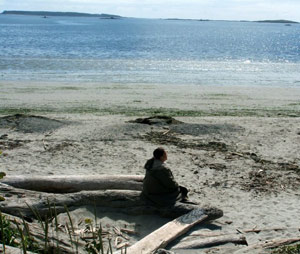
Like a healer, it reduces stress and produces scientifically proven physiological benefits such as lowering blood pressure, cholesterol and muscle tension. Like a protector, I have heard inner warnings while meditating. In one instance, I felt urged while meditating to find a new apartment prior to my outer knowledge that burglers were breaking into the building where I lived. In another instance, meditation carried the inner message to look for a new job prior to finding out that my area at work was targeted for downsizing. Lastly, like a lifelong friend, the inner communion with God while meditating has engendered a feeling of self-acceptance and unconditional love towards myself and the world around me.
I know of no other element in my life that makes easy work of serving so many purposes. Good marriages usually last precisely when one doesn’t seek to meet all needs only from one’s spouse. School teachers know they cannot accomplish their job without a student’s needs also being served by parents and other caretakers. In virtually all aspects of society, specialization and compartmentalization abounds. Only in meditation can we find something that rises to the task of being all things to all people. While acting in myriad ways, meditation rhymes with wisdom and offers the curious paradox that in some instances less is truly more than most.
Sharani Robins
Rhode Island - USA
Never read Proust. Ever since I was told his sentences were like miniature novels in themselves, the prospect just seemed like Too Much Work. But the title is fascinating, don’t you think? In Search of Lost Time. Ah, the imagination-bird leaves its falconer’s glove, and the plot elements assemble in your being one after another like dominoes – our hero, now in his sunset years, facing immanent death, perhaps, or perhaps some little thing has reminded him of his childhood, and he begins to wonder, reflect on a life spent Being Much Too Busy, wonder what was the point, wonder is it too late to make a difference, what would it have been like if he could live it all over again…
Somebody else will have to write that novel. One writes from experience, and thankfully I’ve no real experience of regret to draw upon. That’s what a regular practice of meditation does to you, I’m afraid. I know I once had a whole bunch of what could have been promising plot material, all those juicy what-might-have-been’s I had carefully nurtured out of the crossroads of my life, but they’re all looking a bit withered and prunelike now. Rather inconveniently, I quite like where I am now, and every twist and turn of my life I see only a golden thread leading me here, every success and misfortune I see only as an experience inching me closer to the source of my being. At some stage the voice of common sense pokes through and says, hey, let’s face it, the past is a meatless bone, stop gnawing on it. Even harking momentarily back to those days and recalling how you felt seems a pointless gesture, a trip into the wasteland.
Let’s start again. At the risk of making the novel sound like a thinly veiled autobiography, let our hero have some period of existential uncertainty faced with the mortgages and company cars of early adulthood (a brief one, we hope, for existential uncertainty can be an exceedingly unpleasant business) and then stumble across some means of prayer or meditation or reflection, something that nourishes his soul. Let him have good days and bad days, days where his inner being flies like an albatross and others where it squats apologetically like the long-condemned dodo; only let him keep at it. Slowly but surely they arrive, a trickle of kings bearing gifts across the desert; a little peace, a little joy, a sense of purpose, a drawing out to one’s fellow man; then what? What now of our enigmatic title? A recherché. Perdu. Something he knows is there, deep inside him waiting to be uncovered. But not time, I hear you remark. Peace, joy, bliss, the source of all these things, but not time.
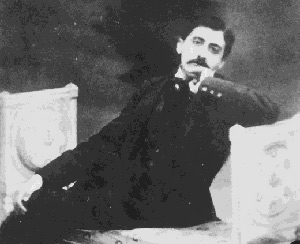
Hear me out. Meditation and prayer do their work noiselessly; they purify, simplify, separate the important from the unimportant, and imperceptibly overboard slips each regret, fear, doubt, without even a splash. Most importantly of all, though, goes the desire for personal gain. Our hero is an Extremely Lucky Man, for there are not all that many truly happy people out there. He is beginning to realise this, and the empathy he has developed through his practise with his fellow beings walking this earth with him is making him feel that perhaps he can do something, there is some little capacity he can offer to heal the division and disharmony that cleaves us apart, for he knows now that his own self-expansion and the betterment of humanity are one and the same.
And that is when his meditation is finally brought into the world. The most ordinary snippets of his conversation, even his smile pours goodwill into everyone he meets. The search for lost time begins in earnest, not in the past but in each and every moment, every decision between betterment and mediocrity, every habit of lethargy and procrastination overturned. Only a few decades left on this mortal coil and so much to do; the human lifespan seems so pitifully short once one has finally found a use for it.
OK. That’s the plan. Someone will still have to flesh all this out into book form, as long as they know of course where the lion’s share of the royalties are going.
Shane Magee
Dublin - Ireland
Over three intervals in late May and early June, 2001, Sri Chinmoy – poet-luminary and spiritual teacher - wrote seventy short poems that were published under the interesting and hugely appealing title ‘If I could start my life once more’. These poems became his 70th birthday gift to us all. While contemplating September’s Inspiration-Letters theme (the vast panorama of meditation) my eyes fell upon this enchanting and irresistible title in my bookcase and I devoured its contents with much relish and head-nodding. Here I would find such charming little gold nuggets of wisdom that what might have been the burden of my task became a joy...
If I could start my life once more,
I would be seriously in love
With God-manifestation-victories.
- Sri Chinmoy
One of the fruits of meditation is self-knowledge – and one of the gains of self-knowledge is a growing understanding of our soul’s promise and purpose on earth. This rarely comes as a sudden revelation but emerges instead over a handful of years, a precious fruit ripening on our life-tree or a slow and gradual dawn. Impatient to find our way, our soul’s divine tasks, we often feel frustration at the murkiness of our future, the uncertainty of our way forward, but everything is a readying, a preparation for what will come next.
In my own first years of learning meditation I felt such a growing urge to do something, an awakening purpose of the soul, and along with my equally restless companion Subarata, repeatedly petitioned Sri Chinmoy to liberate us into the future that was stirring inside us. He would say ‘Soon, soon - but not yet, not yet…’ and three long years would pass before his ‘Now, where would you like to go?’ sent us off, two slingshots released from their restraints and flying away to a distant shore. It was here in New Zealand that we would begin to attempt our God-manifestation-victories and fulfill our souls’ promises.
Years later an ailing Subarata would embark alone on a journey to an even more distant shore. But all this lay hidden from us then, the heartaches, griefs and smiles of the unknowable future.
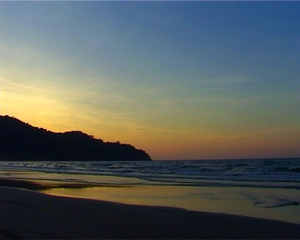
If I could start my life once more
I would never miss my God-Invitation-Hours.
- Sri Chinmoy
On our path the disciples’ first daily God-Invitation-Hour is their 6am meditation – God invites us and we invoke God, a mutual entreaty. This and hopefully other daily interludes at our shrines provide the inner foundations of discipleship, the blossoming and transcending impulse towards God. Spiritual masters are like meteorologists or weather forecasters – they clearly see the patterns of inner weather that impact on all of humanity, warn us of advancing storms or urge us on through balmy times of temperate weather.
In 1994 the entire year was one long golden spiritual summer – a time of unprecedented opportunity for all seekers of every path to make extraordinary progress. In January of that year Sri Chinmoy spoke at length of the remarkable coming months and invited us to meditate seven times a day – seven God-Invitation-Hour opportunities – telling us of the great benefits this would bring.
In the midst of our lives, in taxis, on buses, at work, at mealtimes we tried to prioritise our 7 x 5 minute meditation-invitations as though racing towards a suddenly palpable goal. 1994 was an express freeway and we were all taking the fast lane to Heaven.
If I could start my life once more,
I would enjoy only the silence breath
Of my God-Aspiration-Ecstasy.
- Sri Chinmoy
Sri Chinmoy tells us – and he really does know firsthand - that God is all delight. Since meditation gradually reveals our soul’s oneness with God, the first intimations of this oneness can bring a little whiff of ecstasy. This has proven true even for a worst-case scenario student like me.
Once, reclining in the back seat of a car while driving somewhere in upstate New York, I had such a feeling as this come upon me – still mind, silence-breath, a sudden random joy like the surprise of a summer rainbow. I forgot who and where I was, where I was going and everything became still - inside me a rapture of pure consciousness like a light suddenly turned on. It was a little inadvertent moment of grace and I was overcome with a lovely delight.
Advanced practitioners of meditation can ride the silence breath of their God-aspiration to these and much higher planes of ecstasy at will. Too much of this though and we might be disinclined to attempt our God-manifestation-victory responsibilities. That is why Sri Ramakrishna withheld from his closest and dearest disciple, Swami Vivekananda, the knowledge of his true nature, his soul’s God-oneness delight. Had he become too immersed in this ecstasy the soul would have left the body and gone straight back to its home high above, his work on earth undone.
If I could start my life once more,
I would become every day
A new morning rose
In the garden of the universe.
- Sri Chinmoy
Every day most of us do, say and think lots of little things that are in some measure regrettable - our spiritual journey becomes burdened and delayed by their weight. We gather up these samskaras or residues like a bee gathering pollen and these become an energy, a force that accumulates and impacts on our consciousness. The good news is that all this stuff can be discarded each day – we can rid ourselves of these debilitating burdens and start afresh. With precisely this in mind Sri Chinmoy has written a number of mantric songs that he encourages us to sing with great sincerity each morning – they ask God the Father or Mother to forgive us and if we can sing these redemptive prayer-chants with an absolute and soulful sincerity, the slate is wiped clean! In your meditation or in your singing you can begin to feel when this has happened – it is quite clear. If through your songs or your God-Invitation-Hours you can really cry out and run towards God like a child, God the Mother/Father will enfold you, unburden you – you will every day become a new morning rose in the garden of the universe.
If I could start my life once more,
I would have equanimity as my name
To brave the buffets of life.
- Sri Chinmoy
Sri Chinmoy once reassuringly said ‘I sincerely admire you people, I know how hard it is to be a disciple’. Part man/God/beast how we struggle with the polarities and complexities of our human nature, the shadows and light as we walk our long road to happiness. In the late 80’s, a rookie disciple with lots of rough edges and equanimity as unlikely as a Martian invasion, I came across a revelatory comment by Sri Chinmoy that propelled me forward on a personal fast-track: ‘Every action of ours should be to please God and not to gain applause. Our actions are too secret and sacred to display before others. They are meant for our own progress, achievement and realisation.’
This touched me deeply, a thunderbolt of understanding and I suddenly felt gratefully free of any wish for acknowledgement regarding any of my actions. Later, having served my equanimity apprenticeship in minor challenges – advancing baldness, unwarranted personal attacks on my saintly character, major dental problems, unemployableness, the multifarious blooms of unhappiness – I was at last put to THE BIG TEST. A major three month project I’d worked on came to a successful conclusion and someone else handed the results to Sri Chinmoy. ‘Marvelous, marvelous!’ he exclaimed, beaming at the good news bearer and assuming that this person had done all the work. For a moment I grappled with the unholy desire to snatch the nearest microphone from its stand and announce ‘EXCUSE ME EVERYBODY COULD I HAVE YOUR UNDIVIDED ATTENTION FOR A MOMENT PLEASE – ACTUALLY IT WAS ME, YES ME WHO DID THAT, OKAY. THANK YOU! AS YOU WERE!’ But instead I wrestled this impulse down and soon felt triumphantly detached, beached on the calm shores of equanimity.
In coping with the slings and arrows of outrageous fortune – the ‘buffets’ – a sense of humor really helps. It’s also good to spend more time at our shrines to harmonise our inner and outer lives more, and in trying to convince ourselves that Somebody really loves us. Yes, I know, I have trouble convincing myself of this too, but deep down I do believe it’s true – and all the Avatars agree with me on this!
Another thing that helps is an unswerving belief in enlightenment. On a really bad day when you feel far away from God, your Guru, all of humanity, your handful of friends, and your whole raft of reassuring beliefs doesn’t work, you can still practice your equanimity and look up at the sky and breathe in the vastness and peacefulness of the cosmos and know that one day, one day, you’ll be free of all this. But to go back to my earlier story and Guru’s lovely remark about secret and sacred action, try working on a Centre project for six months then not telling anybody, certainly not your teacher, what you have done – only God knows and He’s staying quiet to test you. This is pure unconditional service - karma yoga – with absolutely no expectation or hope of recognition or sly self-promotion. This way you can realize God in about two months, instead of the leisurely six month program you’ve probably settled for. Fasten your seat belt, you’re on a roller coaster ride to Heaven.
Jogyata Dallas
Auckland - New Zealand
Photographs by Kedar Misani and Antara-Prabhat Ethan Kalagian
When I returned from the World Harmony Run last year, I cleaned out my room throwing out lots of useless junk- old clothes, broken alarm clocks and sentimental keepsakes that had long lost their value to me. I also took a long-planned trip to Germany, caught up on my correspondence and launched Inspiration-Letters with the help of my friends. The energy that I got from running across the country for world harmony and peace I applied at home. That six-week long running adventure was actually a kind of meditation that uplifted me and transformed my life.
Meditation isn't just sitting with folded hands in front of our shrines. We can turn every action of our lives into a kind of meditation. But I still think our daily practice is essential to maintain equanimity. When we consecrate a little time each day to reflection and prayer, I think we eventually get sharper, more discriminating and more careful. We can tell the real and the true from the false and the flaky.
Carl Sagan once said something like that it is through human beings that the universe is aware of its own existence. I like this idea, that through our spiritual search and growth we can offer the whole world more self-awareness. That's a great motivation.
I love Cezanne and Beethoven so much because they created art that reflects a deep spiritual awareness. They both slaved and struggled to get exactly the right effect, the right shade of color or tone, so as to be totally authentic to their own inner voice. Would that more artists could follow their example!
I'm really grateful to Sri Chinmoy for his clear and simple teachings about meditation. He writes that meditation is a totally normal practice and can help us to become stronger and happier people.
I began to meditate not only to find God but also to become a better writer. Meditation has enabled me to write in a more natural and spontaneous style. Interestingly enough, I find that I can meditate and write at the same time, to a certain extent. I mean, after ten years of practice in meditation, I've learned how to put that equanimity, poise and profundity to good use in many fields, and especially in creative expression.
In his immortal introduction to the English edition of Gitanjali by Rabindranath Tagore, William Butler Yeats writes: 'We write long books where no page perhaps has any quality to make writing a pleasure, being confident in some general design, just as we fight and make money and fill our heads with politics- all dull things in the doing- while Mr. Tagore, like the Indian civilization itself, has been content to discover the soul and surrender himself to its spontaneity.'
Meditation is a key to a more beautiful and fulfilling life. There's no end to our self-discovery. If our aims in life are high and elevating, then why should our lives also not be beautiful and fulfilling? Meditation is a good and practical way of living your dream and making your dearest hopes come true in the here and now.
Mahiruha Klein
Philadelphia - USA
Photograph by Pranlobha Kalagian
In Praise of Whites
I bought myself a pair of whites
The year was '87
They shone resplendent, clean and bright
I thought I'd gone to Heaven.
I thought "let's see how tough these are"
I played a game of soccer
Oh God the mess, I could've wept
I flung them in my locker.
A week went by, I couldn't sleep
I even phoned my mother
"My boy" she said "just trust your whites,
They're sturdy like no other."
I listened to her sage advice
My doubts I had to squash
I took them to the laundromat
Committed to 'The Wash'.
I watched the minutes ticking by
My heart was all aflutter
First wash, then rinse, then spin, Oh God.
My knees had turned to butter.
I wrung my hands, I looked on high
"Oh Lord, I may erred!"
The wash attendant hung her head
For clearly she concurred.
At last the fateful moment came
I lifted up the lid
Oh yippee yippee yippee yay!
I chortled like a kid.
My whites were spotless, gleaming white
As pure as winter snow
"Oh Lord!" I cried, "a miracle!"
My face was all aglow.
So brothers dear, revere your whites
My words you mustn't mock
And should you yearn for extra grace
Just wear them round the clock.
And when 'tis time to leave this world
And no one can arouse ya
Ensure your mortal frame is clad
In-yes-your laundered trousa.
Yes, when the soul has fled the cage
Winged upward to the light
Make sure you're scrubbed up, buffed and clean
Angelic all in white.
And when the good Lord finds the time
To have a tête-à-tête
Be sure you're free of curry stains
For God's sake don't forget!
– Jogyata.

Tea With A Neighbour
Sometimes I spend half an hour with a ninety-year-old neighbour two doors along on my street. Some say she is a little mad but her human face, the polite masks and conventions of behavior, have simply been stripped away by time. I had a cup of tea with her the other day and she shared some photo albums with me. A recent life of brave travel, taking refuge from loneliness in perpetual motion. Here she is in Hanoi, a solo journey aged eighty-eight, with a boa constrictor wrapped around her neck against a backdrop of dark green jungle; and here in Kukup, Johor, aged eighty-seven, stepping off a game fishing boat with a beaming Indian guide; and now in Singapore last year, in a wheelchair and aged eighty-nine, dark glasses, mad lady tourist laughing with a group of Asians in a fruit market.
Other snaps from much earlier, pushing a pram with her first daughter, and sepia brown shots of now deceased family. The long trajectory of a life encompassing so many pleasures and pains, albums of memories that might be best discarded. She has outlived all her children and her seamed face shows the hurts of this. She tiptoes among nihilistic trapdoors that might open up at any moment to an unbearable nothingness, an emptiness like a worm hole into a dark universe. No returning from that breathless place. She treasures her photos, a sanctuary and consolation prize and evidence too of some lingering structure and purpose in the waning years, though they open bleeding wounds-relishes too the solace of company, a reprieve, and grasps my arm pleadingly when I move to go. The albums tumble off her knees like falling lapdogs.
She writes sometimes and I ask her to show me. She hesitates, and we both know that the truths that really matter to us, the feelings that we experience most deeply we can never write about nor ever confide to others, not even to a diary. And only rarely might there be an empathetic heart close enough to set aside masks and masquerades. And who would she write for – or do these self-revelations not require a reader, more a confessional whispered to a blind and deaf universe or to a silent, complicit God?
True candor falls outside the protocols of human society and we are never free enough of self-consciousness and our personal public fictions to reveal much of ourselves to others. Yet she promises to show me her written words though our real self-truths, unspoken things, silent hurts, the elusiveness of all that was most meaningful, we often take in silence to our graves. 'Next time', she promises, an inducement to come back, though I will visit again with or without her opened diaries. She looks at me, seeing me as I am with the clear, dispassionate eyes of someone who is past dissembling. I give her a little aphorism of Sri Chinmoy's on a card and depart:
My Lord,
Do teach me only one thing:
How to love the world
The way You love me.
– Jogyata.
Inspiration-Letters 3
Science Issue
 Dear Reader,
During my last year at college a famous scientist, whom I greatly love and admire, came to our school to give a lecture on recent developments in genetic and nuclear technology and its likely moral implications. I fell asleep almost immediately and remained so for the entire lecture. I woke up half an hour after everyone else had left and the auditorium was dark.
I felt so bad! I mean, this brilliant scientist who’s won all kinds of honours and awards came to my college and I fell asleep for the entire lecture.
Three years later I again saw this particular scientist, at a train station. A small, unassuming man, he was dwarfed by the giant suitcases beside him.
I approached him and introduced myself and told him that I had been fortunate enough to see him lecture at my college.
“Did you stay awake for the entire lecture?” he asked me.
I swore that I had and he said that that meant I was a rare student.
He then asked me whether I was still in school and I told him that I had recently graduated and was now looking for a job.
“Your first job is the hardest to find. All the other ones are easy. But it’s your first job that’s the hardest to get.” He said this with a big smile full of warmth and encouragement.
I had to excuse myself then because I had to catch a train. The scientist shook my hand vigorously and wished me well. I was moved by his kindness and concern for a total stranger like me.
I like what Swami Vivekananda once said about his hopes for the union between East and West: “We want today that bright sun of intellectuality, joined with the heart of Buddha, the wonderful, infinite heart of love and mercy.” I admire people, like my scientist-friend, who combine brilliant minds with hearts of gold.
I admit that choosing a “Science” theme for a magazine associated with a spiritual community might seem whimsical. It interests me, however, that so many scientists take a sincere interest in the spiritual life. Maybe science and spirituality are equally important to see the Truth in its proper vastness. Spirituality gives our outer life meaning and direction. Science can give us a special opportunity to apply the wisdom and inspiration we get from our spiritual disciplines.
For this issue of Inspiration-Letters, I asked the scientists in our community, the Sri Chinmoy Centre, to write articles about their lives in science. I also wanted articles by non-scientists who had interesting or funny angles on the scientific world. The articles they eventually gave me were everything I wanted: insightful, informative and accessible pieces on a whole range of ideas and concepts. I hope the reader will agree with me in thinking this issue the most diverse and interesting one so far.
A childlike wonder at the universe is undoubtedly the common denominator that connects great spiritual figures and great scientists. I think that without this sense of joy at the incredible fact of our existence that life can become banal and monotonous. May these articles, written by scientists and seekers from many different backgrounds, inspire you on your own search for satisfaction and true happiness.
Mahiruha Klein
Editor
Dear Reader,
During my last year at college a famous scientist, whom I greatly love and admire, came to our school to give a lecture on recent developments in genetic and nuclear technology and its likely moral implications. I fell asleep almost immediately and remained so for the entire lecture. I woke up half an hour after everyone else had left and the auditorium was dark.
I felt so bad! I mean, this brilliant scientist who’s won all kinds of honours and awards came to my college and I fell asleep for the entire lecture.
Three years later I again saw this particular scientist, at a train station. A small, unassuming man, he was dwarfed by the giant suitcases beside him.
I approached him and introduced myself and told him that I had been fortunate enough to see him lecture at my college.
“Did you stay awake for the entire lecture?” he asked me.
I swore that I had and he said that that meant I was a rare student.
He then asked me whether I was still in school and I told him that I had recently graduated and was now looking for a job.
“Your first job is the hardest to find. All the other ones are easy. But it’s your first job that’s the hardest to get.” He said this with a big smile full of warmth and encouragement.
I had to excuse myself then because I had to catch a train. The scientist shook my hand vigorously and wished me well. I was moved by his kindness and concern for a total stranger like me.
I like what Swami Vivekananda once said about his hopes for the union between East and West: “We want today that bright sun of intellectuality, joined with the heart of Buddha, the wonderful, infinite heart of love and mercy.” I admire people, like my scientist-friend, who combine brilliant minds with hearts of gold.
I admit that choosing a “Science” theme for a magazine associated with a spiritual community might seem whimsical. It interests me, however, that so many scientists take a sincere interest in the spiritual life. Maybe science and spirituality are equally important to see the Truth in its proper vastness. Spirituality gives our outer life meaning and direction. Science can give us a special opportunity to apply the wisdom and inspiration we get from our spiritual disciplines.
For this issue of Inspiration-Letters, I asked the scientists in our community, the Sri Chinmoy Centre, to write articles about their lives in science. I also wanted articles by non-scientists who had interesting or funny angles on the scientific world. The articles they eventually gave me were everything I wanted: insightful, informative and accessible pieces on a whole range of ideas and concepts. I hope the reader will agree with me in thinking this issue the most diverse and interesting one so far.
A childlike wonder at the universe is undoubtedly the common denominator that connects great spiritual figures and great scientists. I think that without this sense of joy at the incredible fact of our existence that life can become banal and monotonous. May these articles, written by scientists and seekers from many different backgrounds, inspire you on your own search for satisfaction and true happiness.
Mahiruha Klein
Editor

Of Saints And Rabbits
by Barney McBryde
Sometimes a man gets to thinking . . . to musing. . . to mulling things over. . . and it generally ends in a painting.
I spent Christmas with my parents.
Lying under a tree, the clink of ice in a tall glass at your elbow, reading Harry Potter – perfect. “So it is Dumbledore who dies!”
When not lazing about, I chanced upon a photograph in the cupboard in the lounge - a photograph of a painting I had produced during an earlier Christmas break. It set me thinking.
Remember Ronald Lockley who wrote the seminal study on the behaviour of the wild rabbit? How I loved that book as a kid! He also wrote a number of autobiographical books. One was called The Island – about his days living alone on an island off the Welsh coast. How that appealed to me too!
Generations have read potted versions of Robinson Crusoe – never mind all Daniel Defoe’s biblical musing, we all just want to hear the story of a man living on an island. It seems that the man on the island must represent some deep-seated human aspiration – why else is he so appealing? Is he not in fact a symbol of the individual’s withdrawal into himself? Is he not, like the monk in his distant cave, the image of one who has withdrawn from the mundane life to know himself?
What we can forget as we think of the actual man on his physical island, is that at any time we can ourselves withdraw to the inner island, and, like Defoe’s Crusoe, there in the silence and peace, free from all distraction provided by those parts of our own nature which bustle about on the mainland, we can read the inner scripture – we can listen to the silence speak. The man alone on his island is the image that expresses that.
In 1997 I visited my brother in Germany. One day he took time off work and we went on an adventure to Maria Laach and Schloss Burreshheim. We were driving along the banks of the Rhine when Michael pointed out to me an island in the river. On the island stands a convent. The story goes, he told me, that in the days when Europe was emerging from the Dark Ages, the great hero Roland – glittering star of Charlemagne’s court – fell in love on the shores of the Rhine with Hildegunde, the daughter of a local prince. Later, when he had been called off to slaughter his fellow man in Spain, word came to Hildegunde that he had been killed in battle. By the time he actually returned to Germany to exclaim, as Mark Twain was to do, “the reports of my death have been greatly exaggerated”, it was too late. One account puts it thus:
“Hearing of Roland’s death, for days on end Hildegunde shut herself up in her little bower, and even her father’s gentle sympathy could not assuage her bitter grief. Weeks passed. Then one day the pale maiden entered the knight’s chamber, her grief quite transfigured. A last great convulsive sob had torn her lover’s name from her heart, had quenched the flame of sorrowing love for him, and now her soul was to be filled ever with the holy fire of the love of God.”
She withdrew to the island in the river and never spoke to Roland even on his return. How could she? She had found the island within – solitary, self-sufficient, separated from the world by the deep, placid waters of her own contemplation, unswayed by the allure and hubbub of the mainland.
The image stuck in my mind.
A few weeks later I was in Budapest marvelling agog at the glories of the Matyas Templom and weeping at the tomb of Gul Baba.
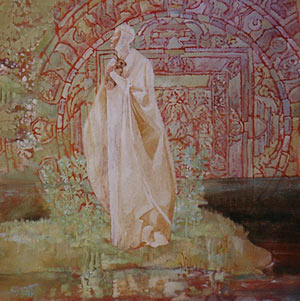
I have a certain dislike of museums but the Museum of Budapest History was undergoing alterations and so entry was free – I entered . . . and enjoyed it a lot. It was here that I learnt about the island in the Danube at Budapest called Margit Szegit – Margaret Island.
Margaret, born in 1242, was the daughter of King Bela IV of Hungary but spent her whole life in a convent. From the age of ten till her death at age 28 she lived on the island in the Danube that now bears her name.
Here again was the woman on the island.
The thing that I found out at the Museum of Budapest History which appealed to me most was that prior to Margaret’s arrival in 1252, the island was obviously not called Margaret Island . . . it was called Rabbit Island.
*
People often question the origins and symbolism of the Easter Bunny. The oft-cited rather basic fact that Easter is about new life and rabbits reproduce quickly is not in fact entirely true.
Before Ronald Lockley carried out his ground-breaking study of the behaviour of the wild rabbit, the strange fact is that very little was know of the life of this ubiquitous creature. Rabbits are crepuscular – being active at dawn and dusk. What nobody knew before – because nobody had bothered to look – was that they are also nocturnal, hopping about in the dark when no humans are there to see.
However, the idea that rabbits were only active at dusk and dawn lead our medieval forebears to conceive of the rabbit sitting patiently in his hole awaiting the rising of the sun, sitting in faithful expectation and hope for the return of the light. The rabbit thus became an image of Easter – not of Easter Sunday, but of Easter Saturday: of the Christian waiting in the darkness of Easter Saturday for the light and effulgent grace of the resurrection on Easter Sunday. As the rabbit waits faithfully and with sure hope for the dawn, so too we wait for the dawning of divine grace in all its forms – the sort of preparatory waiting one might best accomplish free from the distractions of life – like . . . on an island perhaps.
When I got back to New Zealand, these, and other, ideas coalesced into a painting – the photograph of which I just found in my parent’s cupboard.
The painting itself sold about five minutes after the exhibition it was part of opened. It sold under the dignified and elusive name I had given it in the catalogue – “Budapest 1997” – but to me it had always been and would remain – “Maggie and the Easter Bunny”.
Barney McBryde Auckland - New Zealand
Research And Revelation
by Shane Magee
People often ask me if I find a conflict between my research in particle physics and my interest in meditation and yoga. I would answer by pointing to the lives of the great scientists, who braved tremendous opposition in their quest to offer the world new truths, new insights into the nature of reality.
Meditation is not an escape from the world! It is a way, rather, to explore and understand ourselves, and by extension, the world.
I look upon my work in physics as an opportunity to overcome barriers in my spiritual life. Patience is one thing I need more of; the ability to persevere in work without getting attached to its outcome is another. And in the field of particle research you need to develop both of those qualities if you're to stay in the game. After all, results in particle physics have a time-scale of their own, almost wholly independent of how much you push or shove to get them.
Science, in its own right, is a spiritual path of sorts - it may not necessarily lead to the top of the mountain, but the people in that path search for Truth in their own way, and are basically aiming to expand their horizons as best they know how. The same yearning spiritual aspirants have to understand why we're here and what's our purpose is aflame in their hearts too; it's just that they still think the mind holds all the answers.
Or do they? The people on this 'path' of science can essentially be divided into 2 main groups: the rishi-scientists who change the way we view the world (of which in the entire history of mankind there have perhaps been about 20), and then the rest of us who fill in the gaps and do a spot of tidying-up here and there once this new world view has been handed down. The former group are, of course the Newtons and Einsteins, the ones we draw the inspiration from when we look at the world of science, and their accounts of their discoveries invariably have this tinge of divine revelation about them, the sense that their discovery was an uncovering of a higher Truth that had always lain there.
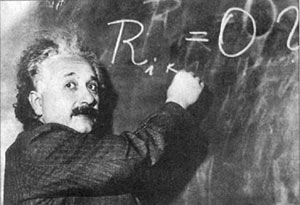
For example, consider this: The modus operandi for great scientific discoveries seems to be to strain and strain yourself searching for the answer until it almost kills you (and in doing so preparing the mathematical framework to assimilate what you are about to receive), and then give up and go for a spot of hiking in the mountains, or something similiar. The French genius Henri Poincaire would describe such a process and then recount how the answer came to him as he was stepping off a bus. Einstein always shaved very slowly in the morning, wary of repeating one particularly bad experience where the Truth burst in on him unannounced. Another great scientist, Wolfgang Kohler, when asked the formula for great discoveries replied -and I’m definitely paraphrasing here-, "Bath, bed and bus." Richard Feynman would describe experiences of floating around in complete bliss for four days after a major breakthrough, which apparently happened to him three times. Is 12 days of bliss enough return for a lifetime of slavery? I’m not sure!
Sri Chinmoy believes you can draw inspiration from different paths as long as you maintain one-pointed concentration on following your own path and don't try to put a foot each in two different boats, as he would say. In my search for the highest Truth, I already have a path, and I'm sticking to it. But when I take my physics research not as a search for Truth in itself but as a golden opportunity to progress in my spiritual life - that's where the satisfaction lies.
This essay was inspired by postings on the Sri Chinmoy Inspiration Group
Shane Magee Dublin - Ireland
Economics - "The Dismal Science"
by Tejvan Pettinger
It is debatable whether economics should actually be defined as being a science. A science like math or physics usually gets its satisfaction from proving something to be irrevocably true. Solve a complex equation and QED that’s the answer, there’s no argument. Economics on the other hand will rarely give us a simple answer. Ask 5 economists a question and you’ll get 6 different answers.
Yet economics could make claim to be a science even if, as John Ruskin disdainfully called it “…the Science of getting rich” (Ruskin 1). Over the years economics has also managed to adopt the equally unflattering label of “the Dismal Science” - perhaps fitting for a subject where even the leading theorists can fail to agree.
We could say economics began as soon as hunter men began to exchange their captured prey with other cavemen. But generally the science of economics did not begin to be formalised until fairly late. However, over the past two centuries, the science of economics has seen no shortage of colourful characters all offering their solutions and diagnoses of the economic problem. This is a small selection of some of the economists who have shaped the subject (for good or ill).
The Dismal Prophecies of Malthus One of the first economists to proffer his theory was T.Malthus. Malthus is chiefly remembered for his essay on population. In this essay, Malthus argued the human race was doomed because the population was increasing at a faster rate than our capacity to grow food. In many ways Malthus was one of the earliest proponents of “The End Is Nigh” syndrome, and unsurprisingly it was Malthus who claimed for economics the label “The Dismal Science”. Fortunately, Malthus displayed a trait that many later economists would share - he was wrong. The population didn’t starve. In fact during the nineteenth century the forces of capitalism flourished creating unprecedented wealth- at least for those who owned the means of production.
Adam Smith - The Invisible Hand One of Capitalism’s strongest exponents was the economist Adam Smith. In his book, The Wealth of Nations, Smith claimed that if people followed their own self interest, then these individual acts of selfishness would have the remarkable effect of leading to the greatest overall benefit for society. This is the basic principle of the book, although Adam Smith did take 1,260 pages to say it (unfortunately, very few economists have ever learnt the art of being concise). Adam Smith has thus become synonymous with support for free market economics. However, many people forget he was rather a modest Scottish intellectual who became chair of Moral Philosophy at Glasgow University (Smith’s other major work was about charity and ethics but it is for his articulation of free market economics that he is chiefly remembered). His seemingly paradoxical argument about the free market has remained at the centre of all major debates in economics. Is an unbridled free market really the best economic system? Nevertheless, even the most ardent free market economist cannot ignore the fact that capitalism creates inequality and in the nineteenth century this inequality was painfully evident. Thus, many economists came along to challenge the free market ideologies of Adam Smith.
Karl Marx - The Revolutionary Economist Whether deliberately or not Karl Marx was destined to play a major role in world history. Basically, Karl Marx was of the opinion that the inequality of capitalism would inevitably lead to a revolution by the oppressed workers and the formation of a Communist state. In fact Karl Marx went to extraordinary lengths to explain this principle. His most important work, Das Kapital, could make claim to be one of the most boring books ever written (perhaps only beaten by Adam Smith’s Wealth of Nations and Ludwig Wittgenstein’s Tractatus Logico-Philosophicus). However in F.Engels, Marx had a companion who was able to help romanticise the ideals of Communism. But despite the various attractions of Marxism, it never really took hold in the US and Western Europe.
J.M.Keynes - The Greatest Economist? Mainstream economists were, before WWII at least, fully entrenched in the free market orthodoxy of classical economics. Just to reiterate, these economists differed little from the original ideas postulated by A.Smith, who held that the free market would create wealth and prosperity. All problems would invariably be solved by the inexorable workings of the “invisible hand” of the market. However in the 1930s free market economics faced a seemingly impossible challenge – The Great Depression with its mass unemployment, bankruptcies and falling output. In the face of such economic hardship the appeal of radical alternatives created serious political turmoil - Western democracy itself was threatened. But many economists stuck to their ideology arguing in the Long Run everything would be OK.
It was thus in the middle of the Great Depression that J.M.Keynes rose to prominence, retorting to orthodox economists: “In the Long Run we are all dead”. Keynes saw no point in waiting a couple of decades for the Depression to come to an end. He argued for immediate government intervention and, in particular, he called for the government to spend, spend, spend.
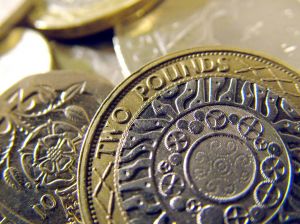
John Maynard Keynes was born in 1893, which was the year that Karl Marx died. Both Marx and Keynes were to write influential critiques of the Capitalist system but here the similarities end completely. Marx was a rather angry loner, many of his enterprises failed and much of his life was spent working anonymously in the British Library. Keynes in many respects was very different; he cut a dashing figure - a brilliant economist, who could also mix with the elite of British society. Keynes attacked the inequities and insufficiencies of the free market but that didn’t stop him from making a small fortune by speculating on the foreign exchange markets. Keynes was also a visionary: While the Allies were clamouring for a victor’s peace at Versailles in 1919, Keynes resigned from the British delegation. He argued the reparations imposed on Germany would be impossible to repay and that they were a recipe for the humiliation of Germany and future problems. His book The Economic Consequences of the Peace became a best seller and in retrospect proved to be a damning indictment of the narrow-mindedness of the allied victors.
Keynes was brilliant at many things and he knew it. Once he was placed second in an economics exam. His only reply was that:
“That shows I know more economics than the examiner.”
Keynes didn’t just restrict himself to economics; he wrote a book on mathematical philosophy (highly praised by Bertrand Russell). He was also a leading figure in the Bloomsbury group of leading artists, poets and writers. Keynes later even opened his own theatre, which like most things he tried his hands at, proved a great success. Keynes was no socialist but this didn’t stop him from poking fun at free market economists. In direct challenge to the optimistic assertion of Adam Smith, Keynes took a different view.
“Capitalism is the astounding belief that the most wickedest of men will do the most wickedest of things for the greatest good of everyone.”
This shows Keynes at his best - happily attacking orthodox views with a panache and confidence that was hard to resist. Keynes may have had many human weaknesses but he was able to brush these aside with his evident genius and enormous capacity for innovation and radical ideas.
It was the effects of the Great Depression that led Keynes to his greatest work. He scoffed at the orthodox free market economists who said the government should do nothing in the face of mass unemployment.
Keynes’s strategy was for the government to intervene, borrowing if necessary. This would create jobs, which would give income for others to spend thus creating more jobs. A deceptively simple idea, but too radical for western governments who were unwilling to borrow. Unfortunately it wasn’t until the onset of the Second World War that employment increased to pre 1929 levels. By the end of the war Keynes was given high regard and he was put in charge of the economic planning for post-war Europe. Unfortunately on achieving worldwide fame he died untimely at the early age of 62. However he has left a profound mark, helping to create a whole sub section of economics (Macro Economics)
About the Author - R. Pettinger (part time economist) I studied Economics at Oxford as part of a degree in PPE. I enjoyed the course immensely. Graduating with a 2:1 degree I made the natural career progression and got a job as a gardener in the grounds of my Oxford College, Lady Margaret Hall.
I was quite happy pulling up weeds in the beautiful gardens but later economic realities made me look for a job with greater fiscal remuneration. Thus I got a job as a part time Economics teacher and have since gone on to teach Economics to A Level students aged 17-19 for the past 6 years.
When people hear I’m an Economist they often they display great enthusiasm that I will be able to solve their financial problems. Alas, this is a false hope. Economists are very good at explaining why the economy is doing badly; we can eloquently explain the causes of bankruptcy and likely economic effects. But when it comes to creating wealth we may mysteriously point to the invisible hand of the market and say all in good time. If economists were really adept at creating wealth it is quite likely they wouldn’t be spend their time lecturing on economics (Keynes of course was an exception).
Link: Economics Jokes
Tejvan Pettinger Oxford - England
Happy Birthday To Someone
by Noivedya Juddery
When I was at school, spending my spare time devouring trivia at libraries, one of my hobbies was finding out which famous people shared my birthday. I was very excited to find that Oliver Wendell Holmes, Jr., was among them. Not that I knew anything about him, but I knew he was really famous, and considered a Great Man (in America at least). A few others shared my special day: dancer Cyd Charisse, actor Lynn Redgrave, author Kenneth Graham, one of the Monkees, the Skipper from Gilligan’s Island... With unbridled enthusiasm, I would read avidly about each celebrity with my birthday, whatever their claim to fame. Then I would tell everyone about their greatness: “Cyd Charisse appeared in some of the best movies ever made”; “The Monkees were a truly superb pop band”; “Gilligan’s Island was better than everyone thinks!”
Most of us are proud of our birthdays, even if they seem fairly unexciting to everyone else. Super-patriotic American showman George M. Cohan, the first entertainer to win the Congressional Medal of Honor, was perhaps disappointed to be born on July 3, 1878, missing US Independence Day by inches. But his father (also in show business) had changed George’s birthday, so that in his self-penned hit song “Yankee Doodle Dandee”, the younger Cohan could proudly sing that he was “born on the fourth of July.” The lyrics have made it sound like the birthday of true patriots, but of course, most of them were born on another day entirely. Though three US Presidents have died on that venerated date, only one (the forgettable Calvin Coolidge) had it for a birthday.
Though America was born on the fourth of July, Jesus Christ almost certainly was not born on Christmas day – previously the date of an ancient pagan ritual. But now, Christmas-born people are upstaged, year after year, by someone who, strictly speaking, doesn’t even share their birthday. They only get one set of presents each year, and as the turkey and the plum pudding are taking so much room, they don’t even get a birthday cake!
(In fact, I always considered that the best thing about my own birthday – apart from sharing it with Oliver Wendell Holmes, Jr. – was that it was NOT Christmas, and indeed, it was just distant enough so that my parents couldn’t use the one-big-combined-present excuse.)
But it’s worth it in the end for the Christmas-born. Not only is their birthday a national holiday, but people born on December 25 tend to lead successful lives. Studies show that this is true, though I’m not certain what these “studies” are meant to involve. The list of Christmas babies is impressive: Sir Isaac Newton, Helena Rubenstein, Cab Calloway, Rod Serling, Little Richard, Sissy Spacek, Annie Lennox…
Of course, every date has its celebrities (and I’ll bet this one doesn’t have anyone from Gilligan’s Island), but Christmas seems to be a good time to be born. Publicity for the Hollywood star Humphrey Bogart always listed his birthdate as Christmas Day 1899, which was later “exposed” as a Hollywood myth. As Clifford McCarty wrote in The Complete Films of Humphrey Bogart, Warner Bros Studios had changed his birthday from the less romantic date of 23 January 1900, “to foster the view that a man born on Christmas Day couldn't really be as villainous as he appeared to be on screen” (McCarty). Interestingly, before his roles in “The Maltese Falcon” and “Casablanca”, Bogie usually played villains.
This would have been one of Hollywood’s strangest publicity decisions. Stars were meant to fit their on-screen persona, so “softening” one of their tough guys with a Christmas birthday seems to defeat the purpose. However, as any of his biographers could tell you, Bogart was the real deal – and that included his birthdate. Bogart really WAS born on Christmas Day.
What can Christmas babies draw from this? Can they take pride in sharing a birthday with one of the great film stars? Some astrologers have suggested that each birthday has a certain personality type, and a quick glance would suggest… nothing much. What do I have in common with the celebrities, named above, who share my birthday (apart from the same star sign)?
Are birthdays as special as we think? Let’s look at people with the same birth dates – not only those born on the same date, but also the same year. Birth twins, at it were.
Start with Charles Darwin and Abraham Lincoln, two of the great figures of the 19th century. Both were born on the same day: 12 February 1812. They were born worlds apart: Darwin in a mansion, to a distinguished west England family; Lincoln in a log cabin, to a poor frontier farmer. Nonetheless, in their respective fields, they had a few things in common.

Both were raised as Christians, but Darwin died an atheist, and Lincoln was reputedly an outspoken non-believer (both were accused of being “godless”). Both had less-than-impressive school records, but self-taught themselves to reach the peak of their professions. Both were "mutaphiliacs", known for their ability to embrace change. Both detested slavery. "It makes one's blood boil, yet heart tremble," wrote Darwin, "to think that we Englishmen and our American descendents, with their boastful cry of liberty, have been and are so guilty" (White and Gribbin 57). Lincoln’s stated objective in the American Civil War was, of course, to end the slave trade.
Both men had major turning points in 1835, at age 23: Lincoln entered politics, and Darwin visited the Galapagos Islands, which eventually inspired his Theory of Evolution. His greatest work, The Origin of Species, was published in 1859 - one year before Lincoln was elected US President. With these events, both would challenge the status quo - changing the world, and winning enemies among the conservatives of the time: Darwin would be denounced and Lincoln would be killed.
In those days, when celebrities did not grow on trees (at least, not to the same extent as today), it seems remarkable that two such outstanding figures were born on the exact same day. According to astrologers and numerologists, however, it is no coincidence.
Whether or not you believe in astrology, there is statistical evidence to suggest that, yes, birth twins tend to have a few things in common. In the seventies and eighties, French psychologists Michel and Francoise Gauquelin studied the birth charts of over 60,000 people, and found that people with similar birth charts seem to have similar character traits and professions (Watson). Independent researchers had the same findings, using different samples. Even sceptics’ groups had these findings, which must have caused them no end of frustration.
In the world of showbiz, people are often matched up due to their astrological compatibility. I’m not sure whether this works, but some birth twins, at least, have proven very compatible. Daniel Day Lewis and Michelle Pfeiffer made good co-stars in the 1993 film The Age of Innocence. Quincy Jones composed the music for the classic 1969 flick The Italian Job, starring his birth twin Michael Caine. Oliver Stone directed Tommy Lee Jones in their two most controversial movies. And a 21 June 1947 birthdate would have helped you win a starring role in Family Ties. (Meredith Baxter and Michael Gross played the parents in that 1980s sitcom.)
Then there are environmental artists Christo (Javacheff) and Jeanne-Claude (de Guillebon), both born on 13 June 1935, who have collaborated on many projects over the past 40 years, and have been happily married for even longer. If you believed in astrology, you would probably say it was written in the stars.
But what does that say about people who, despite sharing a birthday, might have been born years apart? Perhaps nothing. All we can say is that your birthday should be of great significance to you. When it happens, enjoy yourself - but make sure that nobody sings you the song "Happy Birthday to You", because it's covered by copyright until 2030. (As the most frequently-sung song in the world, it rakes in $US2 million in royalties each year - even though most people who sing it don't actually pay anything.)
Above all, see your birthday as something positive. It doesn’t mean you’re getting older; it just means you’re getting presents.
Noivedya Juddery Canberra - Australia
Artistry In The Sand From Tiny Crabs
by Sharani Robins
A universe of natural wonder beckons from all corners of the globe. If I step through the doorway of awe and attention, nothing less than magic awaits whatever the address. Equipped with the naturalist's and explorer's perspective, God's natural creation sings a symphony of majesty.
I ventured out the other day onto the ocean beach, here in Malaysia, for a stroll carrying the odd combination of a script to memorize my lines for an upcoming performance and my camera in case adventure paid me a visit. While I tried to immerse myself in the character, the sand quickly diverted my attention while it shifted as if alive under my feet. Little holes popped up all over like little blowholes on a whale. In the blink of an eye, tiny crabs the same colour of the sand scurried about and disappeared down into the sand or appeared up from beneath the sand.
The sand was also formed into a vast mosaic of mandala shapes that appeared to be like bursts of fireworks exploding on the sand. Some places had tiny mounds that were perfectly formed spirals. Sooner than at once, my script had turned into a knee rest to protect my freshly laundered pants. It was all I could do to keep myself from lying down completely to watch the crabs with complete fascination so that I could better understand their world.
Mostly they disappear under the sand as soon as you come close to them. Actually observing them took some degree of patience and quiet. As I left the world of people aside, I finally began to understand that these crabs would create a little hole by carrying drops of wet sand up and out of the hole and then place the sand carefully around them, first creating their own version of a sandcastle with walls for their little hole. Sometimes as soon as they noticed me looking at them or trying to take a photo they disappeared back into the hole. Somehow I must have eventually adjusted myself more to their wavelength because as time passed and I moved slowly along the beach, I had better and better luck co-existing near them without them scurrying away.
I was rather overcome with awe as I realized that this vast network of spiral designs painted on the sand was the handiwork of tinier than the tiniest crabs (most of the ones I saw were no bigger than my fingernail). These designs in the sand looked just like mandalas created by a human artist. I tried to capture their artistry with my camera but I must confess that the pictures I will put in my online gallery album might not do them justice.
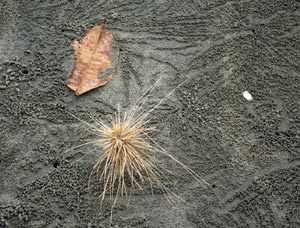
As I made my way back towards the hotel, in the distance I saw a large blue kite being flown in the sky on the beach. My intention was to capture a photo of it from a closer view but I kept stopping, setting my camera to close-up view and kneeling back down in the sand mesmerized by the tiny crabs. They so completely captivated my attention that by the time I got back to the hotel the kite flyer was long gone.
Did you ever know that sand crabs are artists adept at creating great masterpieces? I am continually amazed at the diversity and grandeur of Nature. It matters not whether I am a mere short distance from my house observing swans and ducks or thousands of miles away walking on a beach instead of a bike path. The common denominator seems to be that one step through the doorway of awe offers a sweeping journey into the domain of beauty. And I find adopting the viewpoint of a naturalist brings the deepest peace and satisfaction imaginable. It truly is a meditation for me. Finding divinity in the smallest aspects of God's creation only enhances its glory. Gratitude blossoms inside me every time I am so lucky to walk through that doorway of awe, which can be visited in every clime. I can only wish that someday you would also be lucky enough to discover the crab artists busy at work turning a sandy beach into a masterpiece.
Sharani Robins Rhode Island - USA
At The Beach
by Jogyata Dallas
Poor readers, we inflict upon you such long and tedious manuscripts - and it’s not as though we have anything really profound to say. I’m guilty, too, and you shall be forgiven if you skip past this very unrehearsed piece for a more thoughtful contributor. I’m only going to write something one sentence long – honestly, only one sentence. I promise.
If you lie on your back on the beach at Whangamata on one of these clear autumn nights, the stars up there in the black sky are so thick and mesmerizingly beautiful that you can only stare and stare in the silence of your wonder – before the moon comes up, the huge panorama of the cosmos is spread out in all its breathtaking glory, and you lie spread-eagled in the darkness with the warmth of the afternoon sun still rising from the yellow sand, and the heavens are alive with shooting stars and pulsing with lights from far off galaxies and the Milky Way is a great band of white, a long milky cloud stretching across the universe made up of countless unknowable worlds and I, sitting in my small room rummaging through these impressions and memories and marvelling at the beauty of this world, I remember too that afternoon before nightfall sitting in a red kayak one kilometer off-shore and looking back at the far-off, Lilliputian rows of weekend cottages in the village of Whangamata, framed in its mountainscape of green hills, and feeling the sea beneath me moving up and down slowly as though breathing, the living cadences of tide lifting me slowly up, slowly down, heaving vertical metres of the sea’s sighing, ever so gentle yet perilous beneath and if you tumble out here, alone and flapping your panicked arms in this frigid ocean, chilling to the marrow, you’re heaven-bent boyo, but you battle back through white caps and rising seas and ride a good last wave ashore like a conquering god, whooping with glee, keel grating onto the golden shells and you drag your skiff up into the dunes and now it’s midnights inky-dark except for those riotous stars and the lights of the nearby village are all out, everyone dreaming in their soft beds while above their closed eyes whole galaxies wheel and turn across indigo meadows of sky and you lie in your solitude of darkness filled with a desireless contentment, cradled by the earth like a child curled up, embraced beneath by the warm sand yielding to the hard edges of your bones and flesh, eyes closed in your calm and you sink into a meditative reverie reaching out with tendrils of feeling and consciousness to some hoped for understanding of everything, everything, curled and warmed in the yellow sand, no thoughts, no masks, no words, no self, awareness stretching out into infinity and everything of feeling distilled into a slow smile that moves across your face and you can almost feel the love and sadness of God, His patience and vastness spread out across this universe all around you and felt too in the solemn matrix of silence out of which all sounds and forms emerge and return, you a tiny atom of fragile flesh riding this sad earth planet on its peregrinations around the sun, whizzing across the black void of eternity, a brief spark of consciousness on a high velocity joy ride among the garrisons of stars, a speck of dust in the measureless storm cloud of the universe, then you wake from these musings to feel a sudden night breeze off the sea, soft as butterflies on your skin,
fragrant with seabed flotsam dumped in the last tide – seaweed, kelp, the exoskeletons of pincer crabs and dead fish – and your heart fills with images from long ago, yes the long ago summers of childhood, wandering dunes and coastlines, kneeling over rock pools stranded by falling tides, face immersed in the salty wet and peering into wondrous grottos filled with starfish, the severed orange claws of lobsters, pale sea lettuce, grey crabs scuttling beneath dark and sinister overhangs, spiny things and gorgeous luminescent shells attainable if you only dare to reach all the way down with your child’s hand into those scary water worlds where rows of sharp teeth and watchful predatory eyes lie waiting in silent concealment and my long ago parents were there with me then, my father’s face sometimes reassuringly against mine, plunged into the pool, his eyes magnified and round and laughing underwater at me, his big knuckles grabbing treasures fearlessly from the dark pools, but now gone out somewhere into the measureless conundrum of the universe, puzzling worlds of stars, gone to meet his Maker so my uncle said, returned into spirit and God-oneness – where we’ll all go eventually because we always were, are, will be, players in His funny-sad, bittersweet, cosmic dance-game, each of us playing the starring role in our own private tragi-comedies, wandering like these brilliant, aimless stars throughout eternity, you, me, all of us belonging among the multifarious, multitudinous characters in His great big amusement park universe where, equipped with an essential sense of humour you can enjoy these few moments as your human life few laps around the sun whizz by, a frolicsome romp, learning to grasp that only God is real, everything else an imagining in the mind, and seeing the futility of all striving, pomp and triumph; the vainglory of all action and ambition and thought; the emptiness of all phenomenal existence; the non-existence of an ego ‘I’; the rapturousness of closeness to God, yes, and the final legacy at the end of all our tears and smiles of knowing and understanding that everything that you searched for, in every person, place, thing, and everything you hoped and yearned for in the great solitude of your painful exile from God can only be found in union with Him and as you fall asleep, tired from all the sea air and still with sand in your toes, you’re saying under your sleepy breath, yes, God, do come, do come, do come.
Jogyata Dallas Auckland - New Zealand
 Here's me playing with a ball, and my mum – a while ago now.
Be In Bremen Tomorrow At 3pm
by Kamalika Györgyjakab
I got the flower in Freiburg. It was a pristine and very persistent sunflower, it held its head high up even after travelling under all possible circumstances for seven consecutive days. Somebody said that sunflowers drop their heads quite shortly after being cut from their stem, but this one seemed to ignore the usual destiny of its kind. All in all, it was a very special sunflower and it magnificently tolerated all the hassle of car rides between Heidelberg and Nürnberg, tram rides in Mannheim, bus rides between Dachau and Dresden, traffic jams and bottlenecks around Dortmund... Now, after having seen Berlin, it was with me in Hamburg and it started to fade. 'That is the fate of flowers', I thought. One thing was sure though: I could not have just thrown this flower away. It was too special, it meant too much to me.
I didn’t have much time to ponder over the issue of perpetuating my sunflower. Our program in Hamburg was quite a rush and on top of that we got lost in a suburb of this huge settlement, so it was quite late in the night that I took farewell from my beloved ones and returned to our tiny hotel room. There a strange desire invaded me quite suddenly. 'Tomorrow I want to go to Bremen.'
I checked the maps and it seemed quite feasible, but this idea of mine was not really welcome. I was turning Claire’s program upside down. She was supposed to give me a ride from Hannover to Luxembourg and I was supposed to meet her in Hannover at a certain time next day. But I was dying to go to Bremen! She was nice enough to re-adjust her and her father’s program to my brand-new whim with a sigh.
I happened to share the room with Saskia. Upon telling her about the inexplicable impulse I felt about going to Bremen, she remarked without the slightest enthusiasm 'I was born in Bremen. I even studied there. I just don’t know how I ever lived there, it’s such a small and insignificant place.' This sounded anything but convincing, but it definitely couldn’t alter the plan. There was too strong child somewhere deep inside me and this kid was loudly protesting against all ideas that didn’t involve Bremen for next day. Fait accompli! After a copious breakfast I grabbed my bag, my increasingly ageing flower and I was off for a safe, glacierless, snowless adventure. A couple of hours in a train and I was placing my feet one before another in Bremen. And I was probably beaming with happiness without knowing what on earth was so special about my coming here.
I couldn’t decide whether its streets were familiar or I just imagined having already walked them in another century. I couldn’t decide whether it was the childhood tale of the famous musicians from Bremen that had planted a seed of curiosity and joy in me. I couldn’t decide what I exactly I wanted to do or see here. I just set off and walked merrily. Well before I reached the old town with its huge church (may I call it a cathedral?) and pretty streets, market squares and the renowned Musicians, I found a stream of water and an island-like place. Actually it was just a seemingly shallow and slow-flowing river that went around some city district and embellished a nice and big park with a well-kept windmill in its middle. I just KNEW that this was the place. The place where I had to be exactly then. It was a late September afternoon, but the number of flowery spots, flourishing bushes, blossoms obviously mocked at the calendar. My grandma taught me long ago not to sit down outside in the months that have an “r” in their names (including September). I giggled when this old memory turned up and I sat down quickly before I could obey tradition.
Being three o’clock in the afternoon I decided to meditate there for a few minutes. Every good Muslim finds a couple of minutes five times a day to spend with God. So, what is wrong with me? Let me give God a chance... Brownish-gold leaves were slowly floating away with the river. I was sitting in a kind of a peninsula under a sheltering shadow-donor tree, peace and poise incarnate. This quietest of all rivers came from my right, went around the peninsula and disappeared at my left.
Both I and the flower knew what was next. I touched it once more and then made just one single move. My sunflower was half a meter from the shore, slowly gaining distance from me. I still played with the thought of retrieving it. 'I could still reach it if I stretch a bit', then 'Oh, if I walked into the water I would still stand a chance of getting it back'... But I moved not. Only with the eyes did I follow the sunflower (that no longer was 'my' sunflower)... and felt what it could possibly feel: the touch of shiny cold water, the touch of the sun on the water, the slow but unceasing up and down movements and the pull of some mysterious force drifting it further and further towards the deeper parts, away from the banks and away from any fixed point that could attach it. While I kept my eyes mesmerised and fixed on this ever-diminishing tiny point in a slow but certain current of ever-new water, something happened.
There are moments that break the gridlines of time and run out wildly into the uncalculated and unmeasured freedom of nothing. Moments that cannot be captured, foreseen, grabbed by any watch, any wordsmith, any worldly idea. Moments when the shallow human sense incidentally falls into the coordinates of a giant astrologer and for a second it gets a glimpse of what one thousand billion years of light mean. These moments make one shiver when they bring the breeze of eternity closer to human concept. These moments make one absolutely certain that there is a God, and what’s more, He is tangibly right there, right then...
It was a moment like this. Through a veil powdered with little glittering diamonds – were they tears or miniature waves of this ever-moving fluid medium? – I could perceive an unknown and unknowable stream of love lingering between a little conscious point crouching on a riverbank and an even tinier sunflower vanishing in the distance. A nameless and data-less bliss grew out of this moment and enveloped the afternoon. The sunflower was perpetuated. So was the sacred corner of my conscience that recognised the play and the actors.
According to calendars and watches I spent approximately half of the September 22 afternoon in Bremen. According to the numberless Big Astrologic Book I was given a gargantuan portion of eternity, packed in some earthly seconds. And I came to realise that the previous evening’s almost hysteric yearning to come to Bremen was nothing else than a well-disguised telegraph from the Architect of unearthly time: 'Be in Bremen tomorrow at 3 p.m.' at the right time, at the right place. He only knows how he managed this in and through me, but I was there...
Kamalika Györgyjakab Hungary
I have always loved water. As a child, I would read every book on oceanography I could get my mother to buy me, and I would spend hours learning the names of the world’s oceans and of the myriad creatures that lived in them. It fascinated me, and still does, that so much of the ocean remains completely unexplored, and that the biodiversity in the ocean, although practically unknown, may far exceed anything on land.
I am professionally a waiter but by temperament I am a bookworm, a kitchen philosopher. For most of my life I’ve been able to achieve my goals on the strength of my intellectual tendencies. The American World Harmony Run changed all that. It forced me to use my body to challenge myself and my world at the same time. Here it wasn’t how well I could quote Sophocles that counted, but rather whether or not I could cover the ground with a spring in my step and a cheerful heart.
I just want to say that, after a long day of driving, cooking, packing and unpacking, getting lost and running on long open highways, nothing beats a leisurely swim, whether in a nice heated Jacuzzi that a hotel owner let us use, or just in a nameless lake in the middle of the New Mexico desert- as far away from the tourist traps as you can get.
Ironically, the World Harmony Run turned me into a swimmer. After I got back from the Run I joined a local YMCA and I now swim two or three times a week. If running clears the mind, then swimming relaxes and expands it. Sri Chinmoy noted that running and swimming both have something very special to offer on the spiritual plane, albeit in different ways.
Herman Melville once said something to the effect that if you took an absent-minded college professor into the wilderness, blindfolded him and spun him around three times, that he would immediately make his way to the nearest body of water, intuitively, if there were any water in the whole region. To quote him directly (from his delightfully rambling introduction to Moby Dick): “As everyone knows, meditation and water are wedded forever.”

Water teaches us to be adaptable, to accept life’s changes with grace and poise. On the World Harmony Run, I found myself always on the move. We never stayed in any location for more than a day. We were constantly talking to reporters, teachers, children, old folks and football and basketball players and basket weavers and quilters. The Run forced me to become as flexible as water, as gracious and accepting of other people as water accepts us all with its subtle and gracious touch.
On my last week of the run, I found myself in front of the mighty Pacific ocean. I had started the Run in St. Louis, Missouri, where the Mississippi river flows so languidly and yet so majestically. An east coast born and bred, nothing could have prepared me for the sheer beauty and power of the Pacific. I waded across the tidal flats and baptized myself with a few handfuls of the water. I am grateful to the World Harmony Run for the chance to discover new things about myself, and the inherent spirituality in Mother Nature.
Mahiruha Klein Philadelphia - USA
Bibliography
"Happy Birthday to Someone" by Mark JudderyMcCarty, Clifford. Bogey: The Films of Humphrey Bogart. New York: Citadel Press, 1965
Watson, Lyall. Supernature. New York: Anchor Press, 1973
White, Michael and John Gribbin. Darwin: A Life in Science. New York: Simon, 1995
"Economics - 'The Dismal Science'" - by Tejvan PettingerRuskin, John. Four Essays on the First Principles of Political Economy. London: Smith, Elder and Co., 1862 (Online Text at etext.virginia.edu)
Quiet Christmas
It's strange, this Christmas period. My very first in New Zealand for fifteen years. Our Sri Chinmoy Centre family has vanished away to relatives down country, an odd ritual here like some seasonal homing instinct, a migratory impulse, reflexive and unquestioned and honed through childhoods of summers, of holidays in small, warm seaside settlements where an uncle owns a bach, and Santa visitations. They have vanished as unexpectedly as characters suddenly written out of a play – you are left, a little bewildered on stage, without cast, character, plot or purpose. One or two still come to the centre, often late at night to meditate.
Susebika passes my door like a wraith – unnoticed even by the usually treacherous, creaking floorboards, light as a gossamer leaf on a summer breeze. Others are like elephants, their tread exciting a whole symphony of squeakings and creakings from the joists; even the walls tremble at their purposeful, thunderous strides. How much of themselves they express in the simple act of movement, like a topographical map detailing subtleties of inner landscapes – consciousness and self consciousness, mood, sensibility, intent, or in equal measure their absence.
I have accepted my purposelessness with calm, a seasonal quirk in this vacuum between a waning old year and the resurgent vigour of the almost new. Today a walk downtown – I live only a few hundred yards from Central Auckland but visit seldom, a stranger to my own city. The people are in almost equal part Asian, Caucasian, Polynesian, Maori, Indian and one sees in their children the emergence of a new racial type born of intermarriage between white and brown – children with black hair, Asian or Polynesian skin tones, but green or blue eyes, a sapphires mineral gaze. It's hard not to feel disconnected from this world of shopping and food, a visitor from another planet, skating across the surface of life but not capable of immersion anymore. I pass a camping/outdoors shop and a twinge from my long ago draws me in – coveting a splendid pair of hiking boots, an unattainable alpine sleeping bag at $900, wishing I was up on Mt. Makorako again with one or two friends, Christmas under a clear cold sky garrisoned with sprawling stars.
In a bookshop carrying Sri Chinmoy's titles, I sit down and browse in a corner, sprawling in a deep armchair with an indulgent drink. Upstairs, saturnalian sounds and laughter from the Caledonian Society, it's kilted members winding up for an extended New Year party. Opening up Yoga and the Spiritual Life at a random page, pressed open on a table of etiolated poppies and a bowl of complementary cashew nuts.
My kind Guru reminds me:
God is in you, God looks exactly like you. Right now, you are God veiled. You have put on a mask, but I see through the mask. In the future, you will be the God unveiled. You will take off the mask and we shall see you as God manifested, the open God.
– Jogyata.
A Few Reflections
Sometime after Sri Chinmoy's passing I jotted down some reflections and reminiscences, letting the flow of memory with its sweet things and moments of understanding carry me along...
Late summer is a vivid blaze of green, in the shading boughs of oaks and sycamores at Aspiration-Ground, in the all engulfing mass of driveway vines – but look carefully, autumn is stealing in, a hint of yellow high up in the crowns of trees, in the industry of squirrels, a sudden night chill. Winter stirs in the falling sap. In the afternoon breezes, a slow flurry of falling leaves, tawny golds and browns tumbling down, the season turning on its heel. Many dread the coming months, the long summer of our Guru’s earth-life now in one sense ended, the bereft contemplating the chill of a harsh new season. But no, this is not the case. Guru is alive, and alive too in each one of us, a part of us. There in the silence-nest of meditation we can quickly find him. And the outer goal which he embodied and held up to us is the inner Self within each of us – enlightenment is an act of remembering.
***
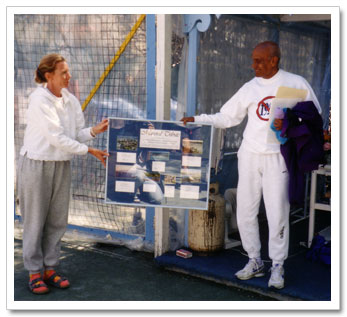 When my wife Subarata passed away Sri Chinmoy said ‘Do not grieve too long, she is alive, she is alive. Do not look for her around you, she is inside you, a part of you.’ How remarkably true that turned out to be. If this is so with another human being how much more powerfully this will prove to be so with a great Master. He who has initiated us inwardly, meditated countless times on our souls, planted aspiration, light, countless blessings in our hearts, assigned inner beings or emanations to counsel and protect us – a part of his own inner reality – and pledged responsibility for our realisation to God. ‘When I am united with the Universal Consciousness, I am in everybody’ he once said. Can’t you feel it?
***
I think that I learnt all of my most important lessons in meditation by simply observing Guru, just by being there around him. ‘God does not expect you to be perfect. He just expects you to be available’. Yes, just being available was almost enough. An osmosis – trying to absorb what we saw in Guru’s face and consciousness into ourselves. Filing by in a walk past or sitting in his company I tried to feel that what I saw and felt in him was also within myself – I am that. So you begin with imitation, imagining inside yourself that selfsame yogic calm, that poise, delight, detachment, radiant peace. Then imagination becomes a reality, you can feel it growing inside yourself – beneath the dross of imperfections your little divine Self remembers and stirs. Sri Chinmoy was a mirror – look hard and often enough and there you are, smiling back at yourself.
***
I woke this morning at 2:50am, floating up to wakefulness from strange faraway dreams. The Brahma Muhurta, Holy Hour, the still point of the turning world – to slip past the painted veil of this world into eternity’s silence, through this opening gateway into an infinite Beyond. One day, yes, but not yet, not yet. Sitting in Subarata’s room to meditate, this room with its so many memories. One small bookcase is jammed with items, memorabilia from her life with Sri Chinmoy – a small silver casket containing plum stones from his mouth, orange peel from prasad given by his own hands, tokens of her devotion, many little poignant things that she treasured. In one corner a small musical box. You wind up the mechanism and it plays ‘Gurur Karma Amar Dharma’ – ‘My Guru’s work is my sole code of life . . .’ – in tiny charming tinkling notes, slower and slower as the spring uncoils. The sweet childlike tones and melody bind the years together in a leitmotif, a refrain of memories and feelings. On the front of the music box a smiling picture of her guru in sailors cap, sitting on the deck of a boat. I remember, I was there. It was Christmas long ago in Tahiti and for half an hour I held an umbrella over our seated master, shielding him from the sun. Someone shouted ‘dolphins!’ and everyone rushed to the side of the boat to watch a gleaming trio frolicking in the sea. Then someone asked Subarata, Irish born, to sing Molly Malone, and after some persuasion she did. The Annam Brahma girls joined in to help. When they sang ‘singing mussels and cockles, alive alive oh’ everyone joined in. It was a very happy day. Like this, each little thing on her shelf carries such sweet echoes of the long ago.
***
In Death and Reincarnation Sri Chinmoy writes:
'When a Master leaves the body and sees that his disciples are crying bitterly over their loss, the Master feels sorry because the disciples do not recognise him fully as a spiritual Master. A spiritual person, one who has realised God, lives on all planes; his consciousness pervades all the worlds. So if his disciples cry bitterly for him, feeling that they will see him no more, then they are putting their Master in the same category as an ordinary person... The Master knows that he will appear before the disciples who are sincerely praying to him or who are meditating and aspiring sincerely. He knows that he will be all the time guiding, shaping and moulding them. He knows that he will be able to enter into them, and they will be able to enter into him.'
I think the easiest way to feel Guru is really alive is to start thinking it, feeling it. Released from the cage of the finite, our Guru’s Universal Consciousness now exists everywhere – our faith, love, devotion, soulful meditations magnet-like bring it into our awareness, into our heart. Devotion and faith create reality because consciousness is the matrix of the universe and shapes it into being. Believing in Guru’s livingness is not an abdication of reason but attunement with deeper fundamental laws, a recognition of a Reality that exists quite beyond the comprehension of the finite human mind. I don’t intend to sound mystical, but belief really allows this reality to come into our awareness and to take birth.
I like the Sri Krishna stories, Arjuna being shown Krishna’s Universal Form on the battlefield of Kurukshetra, or Krishna’s mother looking into the child Krishna’s mouth when he yawned, seeing the universe turning inside him. Sometimes when we looked at our Master, didn’t we also see a little of this, the infinite contained within the finite, the ocean embodied inside the drop, God’s love-delight-immensity-measureless peace-everything there in his eyes, his face. I really think so.
‘Yes, for a while the disciples can feel sad that they have lost their Master, that they will not see him in the physical frame. But that sadness must not last because the soul’s joy, the soul’s intense love and all-pervading concern have to enter into the disciples who have sincerely accepted the Master as the sole pilot of their lives.’ (ibid.)
***
Curiously, since Guru has left behind his physical body so many of us are feeling a renewed sense of energy and commitment, intensity, a rejuvenated urge to manifest, an urgency of purpose. It seems widespread and unmistakable. I think he is working very powerfully in us. Guru writes:
‘When he leaves the body, he is totally free. From the other shore the spiritual Master works through the soul’s light or willpower . . . so from the higher worlds the Master can easily connect with the disciple’s aspiring soul, and the disciple can respond to the Master’s light. It is in this way that the Master can and does and must help the disciple.’ (ibid.)
Sri Chinmoy’s passing seems to have unleashed a great force and additionally a sense of great respect and receptivity around us in the world for who Guru was. Perhaps the passing of an Avatar – as with Christ, Sri Krishna, the Buddha – is a huge tsunami in the inner world, ushers in great change, a resurgence of spirituality. Guru’s Universal Consciousness everywhere spreading.
***
I think we all know that from now on we will all have to prove ourselves, be exemplary. More time at our shrines, and singing our favourite songs, more time with our centre family, go to every celebrations, diminish then discard any eroding bad habits, throw the TV out the window, go to the centre more, let the sunlight of grace into our lives through selfless service, read Guru’s writings half an hour every day, don’t find fault with anybody (yes we know that everyone else is seriously flawed and riddled with blemishes, but practice turning a blind eye), keep fit, find a centre project to serve the world. Long list, big challenge!
That last one, what Guru calls manifestation, is a great task – prove your love for God by service, work, self-offering.
‘Early in the morning, when I hear God's Voice, I open my inspired eyes and meditate. During my morning meditation, God says to me, "My child, go and prove to the world that you are all for Me.’
(Source: A Seeker is a Singer)
I like this little quote of Guru’s very much – it contains one of the banner principles of our path. It is not enough to just meditate – prove your love for God and do something for others, for God the Creation. Filled now with a new resolve a reinvigorated love for Guru’s mission, we can venture out into the world and accomplish great things, fulfill our soul’s immortal promise, spread the Light of the Supreme as Guru taught us to do.
***
Regarding manifestation, Sri Chinmoy’s 13,000th song, Phukai Amara, is one of those immortal gold nugget theme songs of our path that really helps us to feel purposefulness and strength, a thrilling warriors song. I often sing it over and over to myself, especially when I go out postering and flyering (which has got harder over the years!). The English words: "In the battlefield of life we blow the Victory Horn of our Lord Supreme. In our heart-sky we fly the Victory Banner of our Father Supreme." Once, years ago, Guru personally sent me on a Mission Impossible type high level meeting with some of our national officials, telling me to be a ‘roaring lion’ and not on this occasion a ‘New Zealand lamb’. On the plane ride to the capital I sang Phukai Amara all the way, instilling into every atom of my being an unyielding resolve. How powerfully I could feel Guru’s force! Mission Impossible became Mission Accomplished – we were successful despite great odds – and Guru was delighted, which made us all very happy. He said lots of nice things about ‘obedience’ and ‘faith’ and Subarata with her Irish humour said to me ‘This would be a good time for you to depart this world...’
Yes indeed, a good time to leave for the soul’s world, the Master’s praises ringing (at least for now) in our ears, armed with an A+ entry pass to the ineffable Beyond. Oh my!
***
In each of his many endeavours – in the fields of art, literature, music, poetry, weightlifting for example – Guru’s achievements are astonishing and in many cases absolutely unprecedented. But collectively they form a mind-boggling pantheon of accomplishments the likes of which have never been seen before and will surely never be seen again. What an unbelievable legacy for future centuries to absorb. Regrettably, and equally certainly, his inner accomplishments – that great Unknowable Biography of a Spiritual Colossus – will never be known or imagined, so far are these beyond our understanding. Distracted by the human form he inhabited, our capacities too little to see deeply, how could we comprehend that unfathomable, infinite ocean that existed in the finite form of our Guru, a dynasty of consciousness barely glimpsed in his outer works.
As Guru’s physical form was lowered into it’s final resting place we sang songs – 'Oh my life’s Love Supreme, sleeplessly I invoke You' . . . I was reminded of the Egyptian kings, sealed in their vaults beneath great blocks of stone, resting in an endless silence and darkness. The body of a realised Master, too sacred to touch or profane with fire, its presence able to inspire awe, reverence, spiritual awakening, devotion for thousands of years to come, its invisible grace guiding the faltering steps of countless unborn seekers.
This sacred place will become a world shrine, a portal to God like Mecca, Bodh Gaya, Borobodhur, Delphi, Gethsemane, a centripetal force or haven of spirit acting like a spiritual magnet, aligning our waywardness to the pole of enlightenment.
And did you see, in the midst of our singing and tears at the burial, that enormous Golden Monarch butterfly that suddenly appeared and hovered for an age around the side shrine at Aspiration Ground, around Guru’s photo, lingering for an age there, swooping about and hovering. I thought could it be? Could it be . . .? At 2:30am that morning, walking home along the empty streets, ahead of me a girl in her white sari stood beneath a street lamp, weeping inconsolably. Unmasked by the secrecy of night she was shedding tears of grief at the loss of her beloved teacher.
***
Sri Chinmoy taught us many things that are simply not found anywhere else, little secrets unique to our path. And not just taught but brought them into our consciousness as the living breath of our discipleship, drilled us over and over until each lesson had sunk in. ‘Soulfulness’ for example - where else is this found? In our singing – ‘be more soulful!’. In our meditations - ‘please be more soulful!’ Or filing slowly along in a walk-by procession, those wonderful encounters between the disciple’s aspiration and the master’s probing grace – soulfulness! To be as close as possible to the consciousness of our own soul – its sincerity, purity, humility, sweetness – and then to maintain this as long, as deeply, as often, as consciously as possible in ones life. Soulfulness is one of the four rungs of ‘the consciousness-ladder that unites earth’s cry and Heaven’s smile . . . God’s favourite spiritual quality is soulfulness . . .’ (Source: Everest Aspiration)
And then too, all those other secrets to ignite our aspiration like ‘self-transcendence’, ‘gratitude’, ‘oneness’, ‘living in the heart’ - words on a page suddenly brought to life, transformed and elevated into the highest spiritual teachings, our polestars, Guru the Master-Alchemist animating language – inert, passive – into the gold of a living truth and way of being. Under his tutelage and personal example these simple concepts became the foundations of our sadhana, the sap of true spirituality responding and rising up to flower in our lives.
***
I looked through some of the anti-God books at San Francisco airport recently and had to laugh. One or two were quite brilliant and certainly entertaining – but so hostile and arrogant! A sort of irreligious fundamentalism. Trying to contain the mysteries of the cosmos, the boundlessness, unknowableness, immeasurableness of God within the tiny cage of the human brain is inherently flawed. And shows a critical shortage of humility – the awareness of how little is our elfin understanding of everything. Science itself is still a juvenile, barely out of evolutionary kindergarten. Such ratiocination also disregards all the other aspects of human knowing, other forms of non-mind knowledge and perception that are usually undervalued. And disregards the wisdom of the greatest luminaries, the most impressive human souls ever to walk this planet! Einstein very nicely wrote “What separates me from most so-called atheists is a feeling of utter humility towards the unattainable secrets of the harmony of the cosmos. The fanatical atheists are like slaves who are still feeling the weight of their chains which they have thrown off after hard struggle. They are creatures who – in their grudge against traditional religion as the 'opium of the masses' – cannot hear the music of the spheres.”
It might be argued that God-love is one of the highest expressions of intelligence since it exhibits a rare ability to see past the painted veil of ‘reality’ to the very heart of Truth and Reality, the true nature of things. The neo-atheists remind me of truculent, frenetic, unmanageable primary school brats, leaping about scribbling over everything and in need of a good ear-pulling.
***
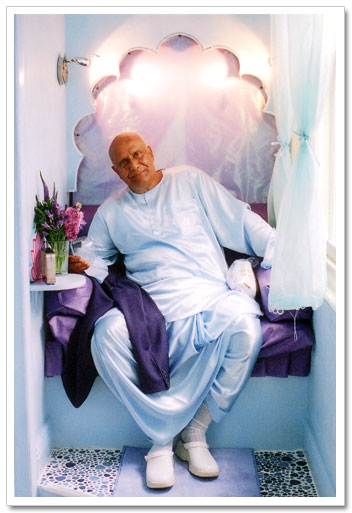 I think one of Guru’s unheralded but truly remarkable achievements has been to make God – the Supreme – an absolutely living reality for so many people. For his disciples Guru’s own intimacy with God was so obvious and compelling, his deference to God in everything he did so moving, and the godliness that he himself embodied so utterly beautiful that he quietly shunted – at least in my case – three prior decades of agnosticism into the waste basket.
Of all the things I have seen in this world, Guru’s physical presence was the most powerful, the most irresistible proof of God. Getting to know Guru was getting to know God – unmistakably this great yogi-soul had realised God and revealed the divine at every moment through his own person and life. God was not a matter of belief or disbelief, a concept to be examined and argued. But there, in front of you, look! I was blessed with a long time to immerse myself in this – my dawning understanding of my teacher’s height was forged and tested and proven over twenty-six years. The Guru is a bridge between earth and heaven, God’s intermediary, a step-down transformer converting the infinite power of the Supreme into a manageable voltage for earth’s consumption.
***
For us the mantra Supreme has become our living bridge to God and often sustains our personal feeling of a loving, caring Supreme Reality with whom we are connected and a part. Guru introduced us all to God, emancipated us from the various handicaps and constraints of our fossilized, past religiosity or indifference and made of God a dear and intimate confidante, one to whom we prayed, opened our hearts, shared our secret thoughts, our worst mistakes, our gratitude and tears. In the light of this sacred relationship and knowledge we can measure what is really important in our lives, or what is not – chart our course with ‘two things absolutely unparalleled; the map for the eternal journey and the courage for the immortal travelling’. (Ten Thousand Flower-Flames)
Spiritual literature down through the ages is filled with profundities, atom bombs of Truth and Reality, gorgeous quotes that thrill the soul, the uncompromising and life-changing utterances of great sages and Masters. They are so powerful as to sweep aside an entire lifetime of cultural indoctrination – that tragic and ill fated love affair with worldliness that we are all immersed in from cradle rock to last breath – and in a moment help us to perceive the highest wisdom and deepest purpose of life, truth stripped to its quintessence. Guru always had that effect in our lives – a Reality Check, bringing us back on course, reminding us what it’s really all about. In the Gita his Guru of long, long ago played such a role.
In a world of enchanting distractions, a culture steeped in material ambitions that suffocate the spirit, how lucky we all are to have this Lodestar, pointing the way home.
***
All quotes above are by Sri Chinmoy.
– Jogyata.
Christmas Trip Notes
Auckland to Punta Cana in the Dominican Republic – two days to get there, two weeks to recover with our spiritual family. On the long haul to North America, thirteen hours plus some, a chance to cram in some of the old unvisited classics on our personal screens. I really liked The Bridges of Madison County with Clint Eastwood – a few furtive tears evoked in this very thoughtful moral debate brimming with tact and sensitivity. Not recommended viewing for disciples yet a really thoughtful look at human love, its quirks and foibles and its sometimes underlying beauty – how is it that this perennial experiment so entrances us, and when it has failed, so haunts us with its memories? Perhaps because our botched human entanglements and sorties were the closest we ever came to love's final flowering in God-oneness, and sensing it in the shadowlands of human life we mistakenly sought its fulfillment there. And it was there too, like a blade forged and tempered by the fire and the anvil, and we would refine our understanding through suffering and loss to at last understand where true satisfaction really lies.
Exiles from the golden land of union with God, we sought Him in each passing face – and He was there but we failed to clearly see Him. And in our human love, its many shades and varieties, we also came closest to being the best in ourselves. In life as in my movie, we are left with the feeling, perhaps not altogether romantic, that human love contains within itself the seeds of something finer, the divine love for which this lesser venture is a watershed. And which will one day find its way to the sea.
In Los Angeles airport they have started playing Christmas songs, brassy if charmless versions of the classics, music whose little personality has been pared away in the search for inoffensiveness but to such an extent that it only succeeds in annoying everyone. After an hour of recycled 'Santa Claus is coming to town' it becomes a mild form of torture until you long to rush down the gateway to your next plane. And recycled warnings in English and Spanish about keeping visual contact with your personal items at all times – everyone staring morbidly at their own bags. In the airport lounges of America everyone has laptops and cellphones and seem obsessed with their own lives, consumed by their dramas and fictions and talking with the blithe confidence of those yet to be dispossessed.
Many people are very overweight. Searching for some half decent food I could see why, settling finally on a Burger King bag of fries and mandatory tomato ketchup. The L.A. airport police, doomed to perpetually roam the limbo of departure wings, have become inflated by relentless bad nutrition into pallid cheeked robo-cops, moving mechanically down the gauntlets of fast and farinaceous food outlets like stiff wind up toys and losing the fluidity that living things have. I feel sympathy – in the space of half an hour I have consumed, out of hunger, mild desperation, the homesickness of displaced travellers, a Starbucks chai, an apple pastry, the Burger King bag of vile fries with its dunkings of ketchup and a choc brownie, looking more kindly at the many fat people forced to swallow similar scraps.
On to San Juan. On this six-hour midnight till dawn flight of comatose Puerto Ricans I am the sole insomniac – crouching, slumping, stretching, twisting, sighing in my tiny seat in a doomed search for comfort. Perhaps even the pilots sleep. My poor body sings with a fever pitch of restless, discomfited energy – the awful L.A. food is exacting retribution. Outside, velvet black heavens are sprinkled with confetti lights, a dark cloth sieved with the bullet holes of stars. Below, outpost clumps of lights, lonely settlements and frontier towns, the reflected glow of great cities. Then orange dawn, battalions of peaked clouds marching far below, wind-sculpted and massed like icebergs, an arctic landscape five miles high.
Then finally arriving after two days of traveling. I catch a mini-van share ride with a Spanish family to the Bavaro Hotel on a flat coast in the Dominican Republic. The father jabbered away to the driver in a rapid dialect and I heard 'musico' and 'Dominica' and surmised correctly – 'don't you Dominicans like music?' – and sure enough the driver jabbed a button and our silent van was filled now with the excitement and exhilaration of Caribbean calypso and drums and trumpets. Each of his two small children sat on one of the father's knees and he bounced them up and down in rhythm while I tapped my feet and the excited kids clapped and sang and rose and fell. Olah! Flat, unenchanting scrublands slide by, giant billboards of Caribbean beaches with their promises of happiness and comfort, of unblemished leisure, warm seas.
But roadside glimpses of less enchanted lives, a figure in the trees, barefoot, looking into tidal swamps and carrying a ragged child; twos and threes indolent with hopelessness or hunger standing like statues; hidden away lives of poverty. Other truths of life to tarnish the billboards idyll.
At the resort the holidayers are a ragtag bunch of foreigners who do not overlap into each other's lives at any point and know as little about each other as when they first arrived. Whole battalions of them, sun-basted bikinied women and their large bellied partners lie supine on orderly rows of shoreline deck-chairs, inert for hours as though anaesthetised by too much lunch. There are gaggles of bellicose, corpulent Russians, distended by long hours propped at poolside snack bars and sun ripening like fat summer tomatoes; excitable Spanish and Italian families with their affectionate, phrenetic kids; geriatric American couples suspicious of everything as the vulnerable become; and the incongruity of disciples, the only fully clad ones here, enigmatic in whites and saris in this strange playground. The beach sooner or later draws everyone. Across a lagoon of iridescent pale blue marbled with skeins of dark weed, a line of white breakers shines where untamed sea ends on coral reefs and sandbars. In the lagoon are dolphin pens with their pontoon catwalks and further out the rectangular boundaries of a shark aquarium. The dolphins dart about in penned captivity and fee-paying tourists dawdle on the catwalks above them – you can swim with the dolphins, grasp a dorsal fin and ride about while cameras click and purr.
In our function room many videos of Guru from the seventies and eighties are shown. I saw myself in one on my first trip to New York in 1981 – a five-mile race and suddenly there I was crossing the finish line. I leaned forward in my chair in disbelief – I had mutton chop sideburns and fuzzy long hair! Subarata too flashed across the screen. Then videos of 'Humour, my life's only saviour' from that very bad year, 1994, and Guru puts on a t-shirt and hat from each country and reads out the jokes we have sent in. I liked the French joke about the wheelchair convalescent who sat in a pool of holy water at Lourdes, hopeful of a miracle. When he emerged from the pool he had two new wheels on his wheelchair!
And some moving, stunning recent footage of Guru meditating in front of his bedroom camera at 3:45am on the Christmas trip in Turkey. He is barely in the body, poised on some cusp between intersecting worlds and veering away from us, remote and otherworldly, even then likely to discard the hindrance of the physical and depart, returning to his longed for Abode. You almost feel happy for his release when you see Him connected to our world by only a tiny thread of love.
There are one and two mile races each week, out and back country lanes surrounded by on one side a golf course, on the other the ubiquitous palms plus dark brooding swamps. Everyone applauding the fastest runners, then we recite one of Guru's aphorisms followed by prasad. Then off to the curly headed sea to swim. There have been Monday a.m. games each week, a tennis tournament, a number of manifestation meetings, many singing groups.
Rediscovering Guru's poetry at my shrine every morning and jotting down favourites:
What am I?
An indomitable spirit
Encaged in an earthly frame.
There has been much talk of the future, of plans and projects. I believe the safety and standards of the centres will greatly rest with centre leaders now. And with the disciples themselves keeping the fundamentals of our path alive and rigorous and disciplined. Joy Days, inspiration, travel to other centres to stay on top.
There is a video by the English disciple Sushumna in the early seventies – everyone seems to have longish hair, the girls in long dyed skirts, and kids everywhere. Guru in his early forties looks happy and pleased and enjoying His earth life adventure as His mission in the West begins to form. The Christmas trip is bringing us all together and providing some sense of a reassuring continuity – and its low-key nature allows much space for fun and the blossoming of friendships and meditations. But we miss Guru in our heart and there is a vacuum here – looking at the large photo above the stage, tears prick your eyes and at times you can't quite believe it or accept it, the sudden unreality of His physical absence. As though some burden of grief remains hidden away in another level of our being, surfaces unexpectedly in random moments. Harder, too, to feel soulfulness, intensity – you have to find this more in your own private spaces, some secret place that you go, or at your shrine during an hour of the day when you feel most deeply. We will have to be careful to protect this, keep this inner link strong where we can find it, feel it.
The Christmas trip is imparting a sense of confidence about the future, and mapping out certain directions. And a further shift away from gravity and mourning toward purpose and resolve – a growing sense too of a living Guru here amongst us, felt, sensed, experienced and surprisingly often, even seen! So many stories one hears that can never be told.
December 11
Rain, rain, rain! And of such intensity and relentless ferocity that everyone is marvelling... Few have ever seen such a protracted downpour that is turning the gardens into lakes, the palm trees into frenzied whips that lash and flail across the sky, the eaves into waterfalls, tempt you to imagine some final armageddon. The sea is boiling with white foam and charging up among the hapless deck chairs, tossing them about like the wreckage of a sunken liner. Along the slippery pathways, lights flicker then die – your mind shrinks from some intimation of disaster, a sudden vulnerability to an implacable, vengeful nature. At 4pm, an hour too early, light fades, the dark sky crackles with veins of lightning – thunder menaces at the edge of everything, encircling and closing in as though summoning its reserves for some final devastation. The tall ringed columns of the palms sway and bend, yielding before the charging offshore winds – against the sky their long fronds stretch like supplicating arms, streaming in unison to the north as though beseeching some god that only they can see.
Faces peer from foggy balcony windows in wonderment. No one is outside lest they are flung away like rags and broken in the wind. Shielded from nature by artifice and comfort but estranged from it as well, we are not used to this savagery howling outside our walls and windows, our sudden sense of frailty. Many will lie fearful in their beds tonight while things bang and clatter in the wind – dreaming of cities tumbling like kitset toys, monstrous waves leveling coastlines, primal winds scouring the land back to its beginnings, the granite carapace of earth. My pen dips into stationery that is turning into porridge, the paper soggy and hygroscopic and melting with moisture.
The adjoining golf course has turned into a vast sheet of water and curious wild fowl are beginning to congregate, dropping out of sullen skies in twos and threes - a brace of blue teal; black swans, ungainly, their plumage dishevelled by buffeting winds; a trio of fast plummeting mallard. They bob among the bunker flags and a partially submerged tractor shed like surprised travellers discovering an uncharted new waterworld. At the eighteenth hole the marker flag crackles desperately in the wind as though semaphoring its distress. In the next morning, we learn that nine people have drowned and 25,000 are homeless.
And in the pre-dawn, post-storm stillness this morning the phone jangles at 4:15am and Shardul is calling from New Zealand, a conference call involving our three Centres hungry for news. Swimming up abruptly from a deep sleep, stupefied in some in-between world where all the familiars are gone. Death must be like this, a release from flesh and masks and masquerades, disconnected from all of the trappings of our human life. The early phone has brought a curious sense of returning from somewhere to what is only the fiction of oneself, perhaps like an actor who, returning to his changing rooms but too long immersed in the play, has forgotten whether his play or his life is the more real. Is he an actor captured by the fiction of the play or a man who feels he is only himself when he is acting? I can hear everyone on the phone and we chat for a while, then I launch into a twenty-minute account of everything. Then discover at the end that no one is there anymore – after only five minutes the line has died. Talking to myself for quarter of an hour. Todays aphorism reminds me:
Follow the ancient disciplines
And pray and meditate
In the small hours
Of the morning.
December 12
Green trousered hotel staff have been labouring since dawn and the beach has been raked, untangled, sanitised, the upended boat wreck deck chairs washed and restored to orderly rows, the storm's debris and mountains of purple ribboned seaweed carted away. The sea too is behaving – our group is out there already, the adventurous swimming away from land like migratory sea lions, their black snouts nuzzling through the pale sea. Last night, December 11, we had a long function occasioned by the second month since Guru's passing. A bhajan concert, many music groups, meditation videos, two walkbys, one in which we placed a candle before our Teacher's portrait, another near midnight in which a single stemmed purple flower was offered by each of us at the stage shrine.
Our minstrels are warming up for December 18 Christmas carols, practicing each early morning. There are regular morning videos of Guru meditating and these are the heart of everything – on the big screen Guru is powerfully there to bring us back on course, summon our soulfulness, provide the strong bedrock of the Path. These will be among the most cherished gems of Guru's legacy for all future time, an Avatar filmed up there in the rarefied air of samadhi where so few have ever been, soaring in the summit-heights of consciousness. Our eyes, our senses become bewitched by the world, but looking at Guru who embodies the end goal of life and the arrow straight path that lies beyond all seeming, we are safe. Jotting into my diary another of Guru's poems:
An ageless river flows
Through the modern aspiration
And dedication-life.
December 13
A beautiful short video this morning of Guru, 1976, talking about Australia prior to his first visit there in that same year. He talks of its unique inner qualities, the height of the mind, depth of the heart, the qualities of its physical, its vital and heart, like a description of the uniqueness captured in a spiritual name. A phrase about how Australia embodies 'the ancient sun' and the promise of 'tomorrow's new dawn'. I remember Guru telling us in the eighties of how – I think it was on that first visit – the soul of Australia, like a tall strong young man if you were to attempt to describe the indescribable soul, came to Guru before he arrived to greet him. It asked Guru about His purpose – Guru made some response about how Australia was good at sports, always beating India at cricket. He had come to bring to Australia a new game, the oneness-heart game.
On my way home a black snake wriggles across the path right at my feet, coiling in exaggerated full loops at great speed.
There have been many meetings about the year ahead but perhaps everything is already in place, the way forward organic and likely to unfold if simply left alone. Guru's physical departing was not untimely or premature and we have been in training for this for a long while. I believe the standards set in the centres will ensure the purity and strength and continuity of the path – meetings between centre leaders to discuss these standards will be very useful.
Follow the ancient disciplines
And soulfully recite
The sacred mantra-incantations.
December 14
One of our disciples flew to a small village in some remote part of the island for an adventure. I hope this third hand account is accurate. In a café he left 'The Son' (Guru's play on the life of Christ) on a table, and returning found a man reading it. He was a missionary, had met Guru in person at the United Nations and presented the selfsame title to Guru for his personal and obliging signature. The man was greatly moved by Guru and had used The Son as a text in all of his later teachings and religious seminars. This unlikely meeting reminded me of the fact that Guru and the centres have touched millions of lives in this way, almost all of these stories entirely unchronicled and unknown. Millions of seeds planted, waiting to germinate at God's choice hour.
Quite recently in Auckland a lady stopped me on the street to ask if I remembered her. I did not, and she proceeded to remind me of a visit I had made to her town over twelve years earlier. Guru's teachings about meditation on that weekend of long ago had changed her life and she had been meditating ever since, rising at 6am every morning and even becoming a vegetarian. These stories are the tip of a great iceberg of life changing/world changing initiatives inspired by Guru, most of it concealed in countless unknown lives but seeding the world with light, one person at a time.
My Beloved Lord Supreme,
Do transport me to the land
Of limitless and ceaseless
Ecstasy.
December 16
It is most pleasant here at night time on the shore. After our function finishes around 11pm you can sit alone on a deck chair, the only person in this long stretch of beach, and close your eyes in the darkness. The ever-present breeze is lovely and the wind pushes into your face, sea-fragrant and rich, invisible though almost tangible like a flowing heavy mist. There are plenty of stars, and white tethered boats toss at their moorings as though playful on the dark seas. The long serrated fronds of the coconut palms sigh against the sky, a soothing refrain all through the night. The Russians are feasting at Los Pinos, the Italian pizzeria, and the daylong deckchair couples are all upright in their holiday best and exercising on the circular dance floor to the strains of Los Caballeros, florid with excitement and another dose of sunburn.
Alone on the beach at this late hour, everything seems ephemeral as though no one else ever existed, you the only being on this coastline. Cocooned like this in nature, the mind falls quickly away and you can practice your meditation. I like to count each in-breath in preparation, count up to one hundred very slowly. You can imagine Guru sitting in your heart, or see Guru's face before you, withdrawn into some samadhi of sat-chit-ananda, and you can emulate this, practice your own attempt at withdrawal from body, mind and senses into pure consciousness and delight. Or imagine your soul bird merging into the overhead heavens, a universe of endless stars.
Once, in this way an hour passed very quickly and I felt pleased that something like this might come so quickly. Or that I had become oblivious of time, a tiny intimation of something. Sometimes I wonder if I'm veering a little off course with some of my meditations though I feel like a goat on a long chain – Guru will yank me back if I stray too far. I hope the chain of my personal love for Guru is strong.
Sometimes at night sudden storms rage across the sea and batter the coast, abrupt and violent, the petulant fury of a sea god, then as quickly abate. The wind roars through the shoreline palms like the breath of a Colossus, the long supple fronds of the coconut palms whirling about like scimitars. Before the rain comes the wind drives the pale golden sand up into the hotel grounds and swimming pools – it hisses through the garden shrubs and slides slowly, defeated, down the ground floor windowpanes like a doomed, sad invasion. After the rain the sky suddenly clears and stars like pale mica glisten in the velvet canopy. Everyone has fled, shrieking, slipping on the wet tiles to their thatched shelters and hotel rooms and you have the place to yourself.
If you follow
All the ancient disciplines
Early in the morning,
Your mounting aspiration-flames
Will reach the Highest
Sooner than at once.
December 18
We will not be together at Christmas and so today has been chosen as a surrogate Christmas day. At our morning function our singers most soulfully perform the usual and beautiful repertoire of Christ songs, with Guru's admonitions from last year read out to remind us to be humble, soulful, without pride. To not sing in the classical musical style, but with oneness and great feeling and devotion. Will Christ visit us prematurely? You would think so, the songs are so lovely their delivery so moving, solemn and lofty. Other Christ songs, Guru's compositions, are also performed, then Guru's play The Son is shown featuring Guru as both Christ and God. Wonderful. Post-lunch, and in droves the disciples head for the beach, a sense of urgency with only four days left. Cramming in as much suntan, joy, camaraderie, swimming, yachting, windsurfing, deck chair dozing and nature meditations as possible. They are scattered across the great lagoon on skiffs, Lasers, kayaks, catamarans. They swim in ones and twos, black seal heads bobbing far out against the sea, eat pizza and drink pina coladas by the gallons.
A festive pleasure boat comes by, two decks of cheering, dancing young people, swaying and clapping to the sounds of mandolins and drums. You have to smile. They line the railings, call out good-naturedly to other boats they pass. Jammed together on the brightly painted boat they spontaneously cheer, urged on by an excited megaphonic voice, gyrate on the top deck as though on a Saturday night dance floor, a floating party. The sounds of their revelry slides left to right across the sea and fades. In the afternoon the sea throbs with music, with the snarl of jet skis and small boats, the throb of diesel engines and outboard motors – in the evening only the wind.
As night comes everyone leaves the beach and the empty deck chairs seem to bask in the fading light as though leading a life of their own.
Tonight others are out to farewell, to search the midnight in that quest that defines us as disciples. They lie quietly on their backs on deckchairs, stargazing under a three quarter moon. The palms lean away from the ocean in the offshore breeze, sibilant and rustling, their fronds gleaming moonlight. There is the Southern Cross, then directly overhead the Seven Sisters, a pale cluster so unimaginably far away that you stare in wonderment; and a close by red star that you suppose is Mars. The many dull stars nearer the horizons all around you give the appearance of tiny pinpricks in a dark, all encompassing veil, light shining through from some other enveloping brightness. I remember Guru saying something about a finite, not infinite universe, then another circumambient reality surrounding this physical universe, then Shiva in deep trance presiding over all this, over all creation, at the farthermost perimeter.
This pleasure life, as we know, is empty of real happiness and even while basking carefree on a Caribbean beach, your toes in the pale gold sand, you can feel the failure of the temporal to satisfy, the familiar knot in your heart and that pensiveness of spirit that has been your faithful life companion. Though these late nights by the sea when others have retired are good enough, at rest in a stillness that is at least a tiny whisper of what you seek – a stillness at least of the mind, though when the mind becomes quiet you can see that everything else is moving, the ceaseless rhythms and arhythms of our planets livingness, trees, sea, late and silent strollers like shadows against the black hem of night, an offshore breeze, and further out a cruise ship, decks ablaze with cabin lights, inching silently across the far horizon. And stars inching across the heavens while you watch, the earth turning, turning, turning as you ride your deckchair across the cosmos.
I told a disciple friend today with a shamefully straight face that recent medical research shows conclusive evidence of cauliflower being linked to premature hair loss. His plate was piled high with the stuff. He told me his mane of white hair confers a geriatric frailty to his appearance and gets him frequent proffered seats on Canadian public buses – he seemed genuinely worried by my pronouncement. I forgot to tell him I was teasing. This is how new diets are formed, lives are changed and how sales of Canadian cauliflower could mysteriously decline.
From everything that you say,
Everything that you do
And everything that you see
In your life,
Just ask yourself one question:
"Am I deriving any
Spiritual benefit?"
December 22
A pleasant afternoon waiting in Los Angeles for my flight to Auckland – pampered and fed like some tycoon in the United Airlines Gold Card lounge. Blue vein cheese, fresh salads, crusty cheese breads and olives – oh my! The gleeful uninhibitedness with which disciples gorge on free food at every opportunity – as though none of us are quite sure when a next square meal will be had. I sense the proximity of other frugal incarnations, most romantically monkish, but more plausibly living under a bridge wrapped in newspaper. In the lounge I find a charming small collection of New Zealand books, one striking compilation of artists' self-portraits with an absorbing introduction. I felt a moments wistfulness for those pre-disciple years of seclusion in the mountains with my collection of treasured authors, reading late into the night by candlelight, silent before the beauty of language and those great and majestic pinnacles of thought, the nearing sense of some final revelation. Tearing the heart out of a book like a loaf of bread.
Literature with its thoughts and insights and its accumulated knowledge of our finest hearts and intellects has been one of my life's enduring loves and yet most neglected and spurned. I have never returned to her after a whirlwind early romance that left impressions, memories and endearments enough to last a lifetime. By candlelight, so long ago, devouring those great books that marked out the territories of my understanding and which I remember still as though it was only yesterday. And to still cherish them – is this a measure of their profundity or of how little I have actually changed? In their presence and the spiritual wisdoms of my Guru's legacy, my own distaste for inserting the 'I' into writing is simply a profound conviction that it, 'I', has nothing much to offer – best leave it out altogether. The critic Laurie Lee once wrote 'perhaps the widest pitfall in autobiography is the writer's censorship of self. Unconscious or deliberate, it often releases an image of one who could never have lived. Flat, shadowy, prim and bloodless it is a leaf pressed dry on the page, the surrogate chosen for public office so that the author might survive in secret. With a few exceptions, the first person singular is one of the recurrent shams of literature – the faceless 'I', opaque and neuter, fruit of some failure between honesty and nerve.'
But in terms of leaving something heraldic behind, Guru's own poem of self-assessment has the last word:
As everybody has to leave,
He will also one day leave this Earth.
But He will be able to say
That He left something
For both Heaven and Earth to treasure:
His Transcendental Consciousness.
– Jogyata.
All poems on this page are by Sri Chinmoy.
- ‹ previous
- 183 of 337
- next ›

Except where explicitly stated otherwise, the contents of this site are licensed under a Creative Commons Attribution-NonCommercial-NoDerivs 3.0 Unported License. read more »
SriChinmoyCentre.org is a Vasudeva Server project.